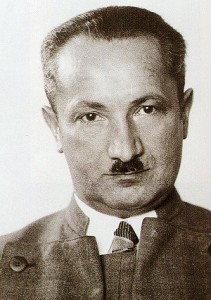
The line is from Martin Heidegger’s resigned and despairing Der Speigel interview, shortly before his death in 1976.
At Rockford College we are hosting a showing of Jeffrey Van Davis’s film on Martin Heidegger’s philosophy and his disturbing relationship with National Socialism. After the showing, we will have a panel discussion featuring director Van Davis, professors David Sytsma and Jules Gleicher of the Rockford College history and political science departments, respectively, and myself as moderator.
Heidegger is one of the most influential of all twentieth-century philosophers, yet he was also a strong supporter of National Socialism in Germany. Is there a connection between Heidegger’s philosophy and his Nazism or is the coincidence accidental? More generally, is there a connection between philosophical theory and political practice? Heidegger died in 1976 — what should we think of his never recanting his support for the Nazi movement even after the end of World War II and the Holocaust?
Time and place of the showing: March 4, 3 p.m., Center for Ethics and Entrepreneurship, Burpee Center, Rockford College (campus map).
From the film’s website:
“Only A God Can Save Us” 
Length: 118 min.
Shot in 16mm, mini DV
Country of Origin: Germany
Shot in: USA, Germany, France, Holland
Persons featured in film:
Kardinal Karl Lehmann, Bishop of Mainz
Alfred Denker, Heidegger Biographer
Hugo Ott, Freiburg University
Victor Farias, Free University of Berlin
Tom Rockmore, Duquesne University, USA
Richard Wolin, City University of New York, USA
Ted Kisiel, Northern Illinois University, USA
Rainer Marten, Freiburg University
Emmanuel Faye, University of Paris
Bernd Martin, Freiburg University
Iain Thomson, University of New Mexico, USA
Jürgen Paul, Dresden University
Silke Seemann, Freiburg University
Rangvi Wesendonk
Axel Graf Douglas, Schloss Langenstein
Some of the topics covered in the documentary:

1. Heidegger’s concept of Being and the “turning” from Dasein to Sein
2. His humble beginnings and staunch Catholic education.
3. The Rectorship and his denunciation of teachers such as Nobel Prize winner Staudinger. His enthusiasm for Gleichschaltung of Frieburg University.
4. His highly manipulative love affair with Hannah Arendt.
5. His relationship to Edith Stein.
6. His refusal to give a word of reconciliation to Paul Celan who visited him in his hut at Todtnauberg.
7. The denazification process and his refusal to recant his support for Hitler.
More information at Van Davis’s site.
I have written about Heidegger here, here, and here.
Posted 11 months, 2 weeks ago at 10:08 am. 8 comments
Tim Black, a senior writer at spiked, has a good review discussion of “Why they’re really scared of Heidegger.” The “they’re” refers to many contemporary academics, and Black’s review is of Emmanuel Faye’s wave-making Heidegger: The Introduction of Nazism into Philosophy in Light of the Unpublished Seminars of 1933-1935 (Yale, 2009).
Some key quotations from Black’s essay with some commentary from me:
“The philosopher still makes some academics feel itchily uncomfortable, not because they truly believe his Nazism will leap from the pages of his works, but because his deeply anti-humanist arguments sound a little too familiar.”
Indeed. In the academic world, especially in the Humanities, we are surrounded by anti-humanists postmodernists, left environmentalists, extreme animal activists, and various other sub-species. (I sometimes wonder whether—for the sake of truth in advertising—we should rename the “Humanities” divisions in our colleges the “Anti-Humanities.” Not that I am bitter or anything.)
Yet there is a bit of a puzzle for some commentators given that, on the usual (ridiculous) Left-Right political spectrum, Heidegger and the Nazis are often place on the “Right” while most of Heidegger’s contemporary fellow-travelers are on the “Left.” Tim Black notes: “Heidegger’s influence is such that any attempt to see the fascist thread loses itself in the weave and weft of an immense, largely leftish legacy.”
So we have to go up a level of abstraction to see the connections. Just as “left” Communism and “right” Nazism are two particular applications of a broader collectivist and authoritarian political vision, Heidegger’s particular philosophy and contemporary postmodernists’ particular philosophy share essentially the same anti-reason and anti-human vision.
Black puts it this way: “The discomfort Heidegger’s Nazism repeatedly causes is revealing. … Heidegger prompts discomfort precisely because he was a Nazi propagating a non-Nazi philosophy. He is just not alien enough. His is a philosophical vision that sits too comfortably with many mainstream attitudes, whether it’s an environmentalist assault upon human hubris or a snobbish disdain for consumerism.”
And of Heidegger’s more abstract philosophical commitments, i.e., his stance against reason and modernity, Black says: “what remained consistent throughout, from the Letter on Humanism to the Question Concerning Technology, was that veiled, abstracted, but nonetheless, resonant critique of modernity, and the human-centred rationality he discerned at its fallen heart … . His thought resonates not because he was a Nazi, but because his criticism of modernity echoes many of today’s anti-modern trends.”
Exactly right. Heidegger’s Nazism is a particular application of his broader anti-humanism, and his philosophical influence has to be understood from that level of abstraction and generality. Heideggerian anti-humanism can be applied particularly in a number of ways, so that is why we find his continued resonance with today’s postmodernists, left environmentalists, neo-Luddites, and man-hating animal activists, and the rest.
My own discussion of Heidegger appears in Chapter Three (pp. 58-67) of my Explaining Postmodernism. Four sections of that chapter are devoted to Heidegger:
* “Heidegger’s synthesis of the Continental tradition”
* “Setting aside reason and logic”
* “Emotions as revelatory”
* “Heidegger and postmodernism”
That chapter is also available at the Explaining Postmodernism page.
Posted 2 years, 2 months ago at 1:59 pm. Add a comment