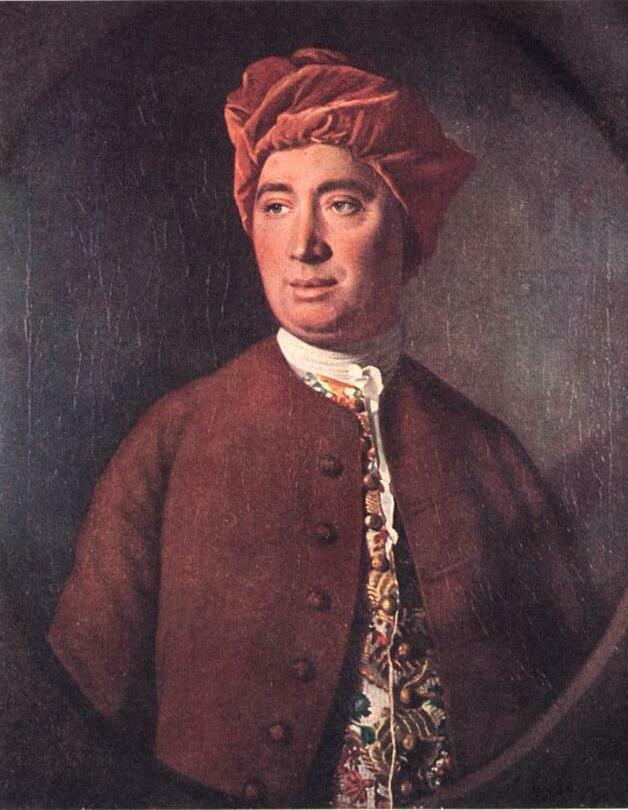
Hume writing to Benjamin Franklin in 1762: “I am sure America has sent us many good things; gold, silver, sugar, tobacco, indigo, etc., but you are the first philosopher, and indeed the first great man of letters for whom we are beholden to her.”
Thomas Jefferson on Adam Smith’s work: “In political economy, I think Smith’s ‘Wealth of Nations’ the best book extant.”
Does anyone know of a systematic treatment of the intellectual connections between the Scottish Enlightenment and the American founders? There is this book by Robert Galvin. Other recommendations?
[Update: David Shellenberger sent me this link on Thomas Jefferson's copy of Smith's Wealth of Nations.]
A key exchange between 3:AM Magazine and scholar Frederick Beiser:
3:AM: But this is the question that German philosophers in the last decades of the eighteenth century started asking: as you put it, they asked, ‘what is the authority of reason?’ They were looking critically at ‘the fundamental article of faith for the European Enlightenment.’ Why did this happen? Was it that philosophers started to see that Kant and Spinoza in particular were potentially corrosive? Hume played a huge role in this didn’t he? You label the early history of Kantian criticism ‘Hume’s revenge.’
FB: The authority of reason became problematic for essentially two reasons. First, there was the revival of Spinoza’s naturalism. Spinoza’s naturalism was taken to be the paradigm of rational thinking, because it radicalized the methods of the new mechanical sciences. But those methods seemed to lead to atheism and fatalism.That raised a question about the authority of reason: should we follow our reason to the end if it destroys our moral and religious faith? Second, there was almost simultaneously the revival of Hume’s skepticism (through Hamann, Jacobi and Maimon). If we follow Hume’s skepticism to the bitter end, we are left with nothing, because it seems we can know only our passing impressions. We have no reason to believe in the existence of our own selves, other minds and the external world, let alone god. The revival of Hume posed the problem of the authority of reason in a very dramatic way. It raised the spectre of nihilism. When Jacobi introduced this word (Nihilismus) it referred to a Humean form of skepticism: that reason leads to nihilism because it does not allow us to believe in the existence of anything but our passing impressions.
Kant seemed for a brief while to give some relief from Hume’s skepticism. After all, there was the transcendental deduction, which seemed to show that the possibility of experience requires synthetic a priori principles.Maimon quickly put an end to this respite: he pointed out that the deduction begs the question against Hume, who would have doubted the existence of experience in the strong sense required by Kant (i.e., the conformity of representations with universal and necessary laws). There was no Prussian bastion to stop the Scotsman’s swift conquest of the territory once claimed by reason. I think that these Spinozian and Humean problems are still very much with us. Here is another reason for going back to 1781 to 1793: it poses these issues in such a clear and forceful way it is impossible not to think about them.
Professor Kline visited Rockford College on Tuesday to give a talk on four major thinkers — Hobbes, Locke, Hume, and Smith — who in large part established the intellectual framework for our modern business world. Kline is a professor of philosophy at the University of Illinois, Springfield. Here is my seven-minute follow-up interview with Kline after his talk.
Part of a work-in-progress in philosophy of economics, here is the video of a seminar I led on “Economics as a Value Science.” Part of my argument is that there is a large, problematic gap in economic theory about the relationship between economic facts and economic values. Along the way I discuss Friedrich Hayek, David Hume, Immanuel Kant, Rudolf Carnap, Richard Rorty, Milton Friedman, Joseph Schumpeter, Ludwig von Mises, Aristotle, and Ayn Rand. The table of contents of the seminar are below the video frame.
Seminar contents:
Introduction
Philosophical issues in economics
David Hume
Immanuel Kant
Philosophical dichotomies
Implications for economics
Economic agents
Policy recommendations
Nature of philosophers
Value
Irrational values and biases
Positivism: Rudolf Carnap
Postmodernism: Richard Rorty
Free-market economists on facts and values:
Quote: Human Action, Ludwig von Mises
Quote: The Methodology of Positive Economics, Milton Friedman
Quote: Rules and Order, Friedrich A. Hayek
Dichotomous problems
Quote: A History of Economic Analysis, Joseph Schumpeter
The Aristotelian approach
Objectivity or subjectivity of values
Objective value thesis
Subjective value thesis
Three-way debate:
Intrinsic value thesis
Subjective thesis
Objective thesis
Values as a species of facts
Biological perspective
Fish example: Facts, Values
Value statements
Human beings: Facts, Values
Value examples
Implications for the subjectivity and objectivity of value
Human valuing
Individuality
Authoritarianism
Free society
Epistemological resources on natural and objective value
Final words
Final credits
More precisely: Who is the most loathsome philosopher in his or her personal life?
Let me set the bar high by naming my top two candidates.
1. Jean-Jacques Rousseau, who fathered several children and had them abandoned to orphanages, and of whom David Hume wrote in a letter to Adam Smith: “Thus you see, he is a Composition of Whim, Affectation, Wickedness, Vanity, and Inquietude, with a very small, if any Ingredient of Madness. … The ruling Qualities abovementioned, together with Ingratitude, Ferocity, and Lying, I need not mention, Eloquence and Invention, form the whole of the Composition.” (David Hume, letter to Adam Smith, October 8, 1767 [Correspondence, 135])
2. Martin Heidegger, who was a Nazi and who, his lover Hannah Arendt said, “lies notoriously always and everywhere, and whenever he can.”
I am open to other suggestions.
Some follow up questions. When one disagrees profoundly with an intellectual’s philosophy, as I do with Rousseau’s and Heidegger’s, is it legitimate to look for a connection between the philosophical and the personal? Or can deep philosophy vary completely independently of personal behavior? Is ad hominem ever a legitimate argument strategy? One should expect integrity, especially from philosophers — i.e., that they will live what they teach and teach what they live — but we also know that hypocrisy is widespread. Should it matter now that influential philosophers were personally immoral, or do only their ideas and arguments matter now?
William Kline of the University of Illinois, Springfield, is an expert on Hume, and he gave a talk recently at Rockford College on Hume’s ethical theory. Here is my follow-up interview with him:
Dr. William Kline, Assistant Professor of Liberal Studies at the University of Illinois, Springfield, gave two talks this month at Rockford College. Here is my follow-up interview with him on the main points of his talk on business ethics (3 clips):
Forthcoming: My video with Professor Kline on David Hume, who, according to a recent vote by contemporary philosophers, is the most influential dead philosopher.
Posted 3 years, 1 month ago at 7:09 am. 3 comments
The Center for Ethics and Entrepreneurship has announced its four guest speakers for this semester:
Roberto Salinas Leon, Ph.D., on business, education, and philosophy in the US and Mexico.
William Kline, Ph.D., on David Hume’s ethics.
Jeffrey Orduno, J.D., on property rights and the law.
Douglas Rasmussen, Ph.D., on Aristotle and contemporary ethics.
Above is a jpeg version of the flyer. For the pdf, click here. CEE’s announcement is here. For more information, email Chris at CEE [at] CEE [dot] edu, or stay tuned for posts updating times and places.
Posted 3 years, 4 months ago at 12:15 pm. 1 comment