Stephen Hicks, Ph.D.

Philosopher

Was Kant really that skeptical?

kant-i-75x83Some readers of Explaining Postmodernism object that I over-interpret Kant’s skepticism. Some prefer a gentler, more objectivity-friendly Kant. So while I quote Kant a lot in making the argument that Kant’s philosophy is radically subjectivist and the critical step down the road to postmodernism, not everyone is convinced.

So I am grateful to Quee Nelson for the following fine collection of quotations from various of Kant’s works, all supporting the Kant-as-subjectivist thesis. The quotations are included in the Appendix to Nelson’s (recommended) The Slightest Philosophy.

“It still remains a scandal to philosophy and to human reason in general that the existence of things outside us … must be accepted merely on faith, and that if anyone thinks good to doubt their existence, we are unable to counter his doubts by any satisfactory proof.” Critique of Pure Reason, B519.

“All objects of an experience possible for us are nothing but appearances, i.e., mere representations, which … have outside our thoughts no existence grounded in itself. … The realist … makes these modifications of our sensibility into things subsisting in themselves, and hence makes mere representations into things in themselves.” Kant, Prolegomena to Any Future Metaphysics, 13, Note II.

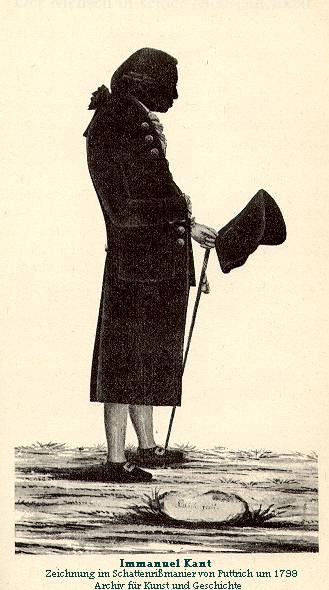
kant-silhouette-75x134“The senses … never and in no single instance enable us to know things in themselves.” Kant, Critique of Practical Reason, Part I, Book I, Chap. I, sec. II, 55.

“Things in themselves … cannot be objects of experience.” Critique of Pure Reason, A385.

“Matter … is nothing other than a mere form or a certain mode of representation of an unknown object.” Critique of Pure Reason, B45.

“Nothing intuited in space is a thing in itself … what we call outer objects are nothing but representations of our sensibility the form of which is space. The true correlate of sensibility, the thing in itself, is not known, and cannot be known, through these representations; and in experience no question is ever asked regarding it.” Critique of Pure Reason, A370.

kant-profile-75x94“External objects (bodies) are merely appearances, hence also nothing other than a species of my representations.” Critique of Practical Reason, Part I, Book I, Chap. I, sec. II, 54.

“The objects with which we have to do in experience are by no means things in themselves but only appearances.” Critique of Pure Reason, B520.

“Appearances are not things, but rather nothing but representations, and they cannot exist at all outside our minds.” Critique of Pure Reason, B235.

“Phenomena are not things in themselves, and are yet the only thing that can be given to us to know.” Prolegomena to Any Future Metaphysics, Part One, Remark II, 288-289.

“The non-sensible cause of these representations is entirely unknown to us.” Critique of Pure Reason, A494/B522.

“As we have just shown that the senses never and in no manner enable us to know things in themselves, but only their appearances…we conclude that all bodies together with the space in which they are, must be considered nothing but mere representations in us, and exist nowhere but in our thoughts.” Prolegomena to Any Future Metaphysics, Part One, Remark II, 288-289.

kant-stamp-75x88“Your object is merely in your brain.” Critique of Pure Reason, A484/B512.

“It is also false that the world (the sum total of all appearances) is a whole existing in itself … appearances in general are nothing outside our representations.” Critique of Pure Reason, A507/B535.

“Since space is a form of that intuition we call outer … we can and must regard the beings in it as real; and the same is true of time. But this space and this time, and with them all appearances, are not in themselves things; they are nothing but representations and cannot exist at all outside our minds.” Critique of Pure Reason, A492/B520.

“The understanding itself is the lawgiver of Nature; save through it, Nature would not exist at all.” Critique of Pure Reason, A126.

“If I remove the thinking subject, the whole corporeal world must at once vanish.” Critique of Pure Reason, A383. [See: Primacy of Consciousness]

“If then, as this critical argument obviously compels us to do, slightest-philosophywe hold fast to the rule above established, and do not push our questions beyond the limits within which possible experience can present us with its object, we shall never dream of seeking to inform ourselves about the objects of our senses as they are in themselves.” Critique of Pure Reason, A380.

“I had to deny knowledge in order to make room for faith.” Critique of Pure Reason, Bxxx.

Source: Quee Nelson’s The Slightest Philosophy at Google books. Also available at Amazon.

Related on Kant:
My interpretation of Kant’s epistemology in Chapter Two of Explaining Postmodernism.
Kant on collectivism and war.
Is commerce rendering war obsolete?
Education: Locke versus Kant.
Philosophy’s longest sentences, Part 2.
Kleist: How Kant ruined my life.
On “giving back”.
Kant and modern art.
Is modern art too complicated for us? [with quotations from Kant's Critique of Judgment].
Heine on Kant: The Department of Great Putdowns.

Posted 2 months, 3 weeks ago at 10:58 am.

2 comments

Phase Three: “I found it necessary to deny reason …”

apple-88x50Immanuel Kant’s famous line from his Critique of Pure Reason is discussed as representative of the change of strategy among religion-friendly thinkers after the widely-perceived failure of natural theology. This is from Part 3 of Professor Hicks’s Philosophy of Education course.

1 clip:

Previous: Phase Two: The rise of natural theology.
Next: Kierkegaard, Luther, and Tertullian.
Return to the Philosophy of Education page.
Return to the StephenHicks.org main page.

Posted 1 year, 9 months ago at 6:32 am.

Add a comment

Kant’s skeptical conclusion

[This excerpt is from Chapter 2 of Explaining Postmodernism: Skepticism and Socialism from Rousseau to Foucault]

Kant’s skeptical conclusion

kant-i-75x83Immanuel Kant is the most significant thinker of the Counter-Enlightenment. His philosophy, more than any other thinker’s, buttressed the pre-modern worldview of faith and duty against the inroads of the Enlightenment; and his attack on Enlightenment reason more than anyone else’s opened the door to the nineteenth-century irrationalists and idealist metaphysicians. Kant’s innovations in philosophy were thus the beginning of the epistemological route to postmodernism.

Kant is sometimes considered to be an advocate of reason. Kant was in favor of science, it is argued. He emphasized the importance of rational consistency in ethics. He posited regulative principles of reason to guide our thinking, even our thinking about religion. And he resisted the ravings of Johann Hamann and the relativism of Johann Herder. Thus, the argument runs, Kant should be placed in the pantheon of Enlightenment greats.[2] That is a mistake.

The fundamental question of reason is its relationship to reality. Is reason capable of knowing reality—or is it not? Is our rational faculty a cognitive function, taking its material from reality, understanding the significance of that material, and using that understanding to guide our actions in reality—or is it not? This is the question that divides philosophers into pro- and anti-reason camps, this is the question that divides the rational gnostics and the skeptics, and this was Kant’s question in his Critique of Pure Reason.

Kant was crystal clear about his answer. Reality—real, noumenal reality—is forever closed off to reason, and reason is limited to awareness and understanding of its own subjective products. Reason has “no other purpose than to prescribe its own formal rule for the extension of its empirical employment, and not any extension beyond all limits of empirical employment.”[3] Limited to knowledge of phenomena that it has itself constructed according to its own design, reason cannot know anything outside itself. Contrary to the “dogmatists” who had for centuries held out hope for knowledge of reality itself, Kant concluded that “[t]he dogmatic solution is therefore not only uncertain, but impossible.”[4]

Thus Kant, that great champion of reason, asserted that the most important fact about reason is that it is clueless about reality.

Part of Kant’s motivation was religious. He saw the beating that religion had taken at the hands of the Enlightenment thinkers, and he agreed strongly with them that religion cannot be justified by reason. So he realized that we need to decide which has priority—reason or religion. Kant firmly chose religion. This meant that reason had to be put in its proper, subordinate, place. And so, as he stated famously in the Second Preface to the first Critique, “I here therefore found it necessary to deny knowledge in order to make room for faith.”[5] One purpose of the Critique, accordingly, was to limit severely the scope of reason. By closing noumenal reality off to reason, all rational arguments against the existence of God could be dismissed. If reason could be shown to be limited to the merely phenomenal realm, then the noumenal realm—the realm of religion—would be off limits to reason, and those arguing against religion could be told to be quiet and go away.[6]

References

[2] E.g., Höffe 1994, 1.

[3] Kant 1781, A686/B714.

[4] Kant 1781, B512/A484.

[5] Kant 1781, Bxxx.

[6] Kant 1781, Bxxxi.

Bibliography

[This is an excerpt from Stephen Hicks's Explaining Postmodernism: Skepticism and Socialism from Rousseau to Foucault (Scholargy Publishing, 2004, 2011). The full book is available in hardcover or e-book at Amazon.com. See also the Explaining Postmodernism page.]

Posted 2 years, 1 month ago at 5:17 pm.

Add a comment