As someone who read and loved the book, this movie totally worked for me.
Schilling’s Dagny is intelligent, emotionally expressive, and beautiful. Bowler’s Hank Rearden is equally intelligent and competent, with occasionally bemused, understated humor and equally occasionally understated anger. And the sexual chemistry between the two — yes, indeed.
Wisocky is tone-perfect as that bitch, Lillian Rearden. The casting of Marsden as James won me over — he could be good-looking, but his inner Jim-Taggart character weasels out and undercuts his potential.
Rand’s original novel is philosophically principled and stylized romantically, so it grates on the nerves of those who are intellectually opposed to a free society and/or who are emotionally cynical or neutered. For the same reasons, the movie will have its automatic opponents.
Also, the movie’s script is a highly essentialized version of the thematically jam-packed original novel, so I sense that the pace of the movie will be a challenge for those who haven’t read the book. (I’ll be curious to hear from those who only see the movie, though.)
Yet the movie is a very satisfying ride for those, like me, who know and resonate with the novel.
Why did the modern economic revolution in production and trade first happen in north-western Europe?
At the APEE conference, Deirdre McCloskey delivered a plenary address based on her new book, Bourgeois Dignity: Why Economics Can’t Explain the Modern World. Her argument is that neither material resources nor technology nor capital accumulation nor geographical factors drove the transformation. Rather, it was a change in ideas and attitudes: the producers, merchants, and traders who make up the bourgeoisie came to be respected. They got dignity, in marked contrast to the traditional disparaging in cultures dominated by the otherworldly, ascetic values of religion and the predatory martial values of tribal warriors and feudal aristocrats.
Respect for the bourgeoisie meant that they went on to develop the institutions of modern capitalism, they became a political force that undermined traditional feudalism and paved the way for modern democratic-republicanism, and the resulting more free political economy became wealthy, generating the science, the technology, and the educational institutions that we are now familiar with. A virtuous cycle was created.
Note that McCloskey’s explanation is in terms of ideas rather than reductive material forces, and in terms of ethical ideas in particular. That is to say, she is arguing that philosophical ideas are the key causal power.
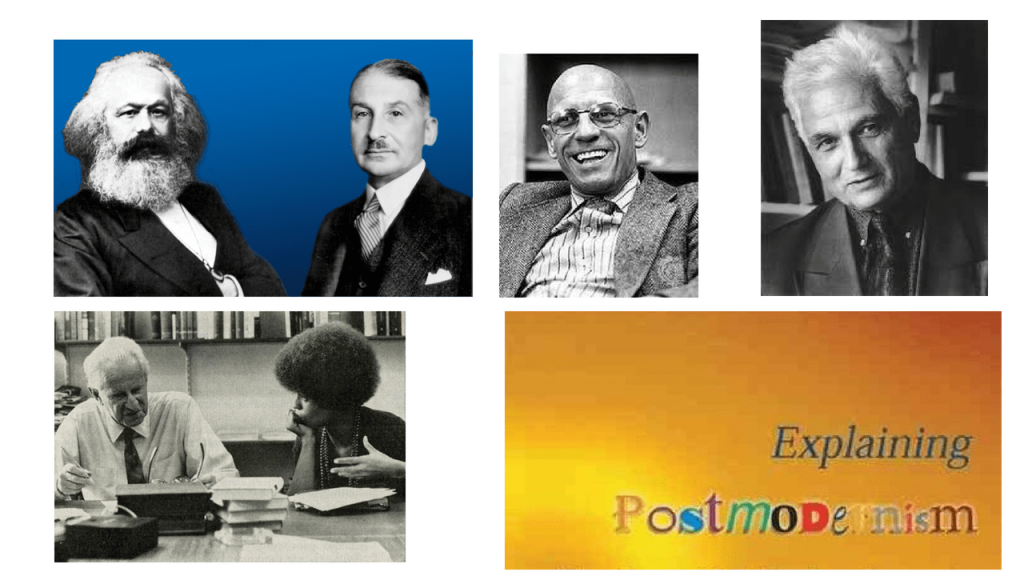
Ludwig von Mises and Ayn Rand had earlier argued for ideational over materialist causes of history. Here is Mises in Planned Chaos (1947):
“The history of mankind is the history of ideas. For it is ideas, theories, and doctrines that guide human action, determine the ultimate ends men aim and the choice of the means employed for the attainment of these ends. The sensational events which stir the emotions and catch the interest of superficial observers are merely the consummation of ideological changes. There are no such things as abrupt, sweeping transformations of human affairs. What is called, in rather misleading terms, a ‘turning point in history’ is the coming on the scene of forces which were already for a long time at work behind the scene. New ideologies, which had already long since superseded the old ones, throw off their last veil, and even the dullest people become aware of the changes they did not notice before” (p. 62).
Here is Rand in For the New Intellectual (1961), focusing more narrowly on philosophical ideas as decisive: “Just as a man’s actions are preceded and determined by some form of idea in his mind, so a society’s existential conditions are preceded and determined by the ascendancy of a certain philosophy among those whose job it is to deal with ideas. The events of any given period of history are the result of the thinking of the preceding period” (p. 27).
McCloskey has been influenced by Israel Kirzner, who was one of Mises’s students. McCloskey’s importance is her is singling out of ethical ideas as fundamental. (Though see also Roark’s courtroom speech in Rand’s The Fountainhead (1943) for the mid-career Rand’s focus on a culture’s moral evaluation of innovators and creators as a key determinant of the course of history.)
Chair: Stephen Hicks, Ph.D., Rockford College, Illinois
Panelists:
Emily Chamlee-Wright, Ph.D. Elbert Neese Professor of Economics, Beloit College, Wisconsin
Title: “Cultivating the Economic Imagination with Atlas Shrugged”
Abstract: In this paper I describe my use of Ayn Rand’s Atlas Shrugged in an undergraduate comparative economic systems course. I argue that the novel is the ideal vehicle for cultivating what I call the “economic imagination,” by which I mean the ability to see the systematic outcomes that emerge under different political economic rules of the game. Further, I argue that the novel is particularly well-suited to animate discussions of essential comparative systems topics, including Marxism, the various phenomena associated with the soviet-type economy, and fascism. Finally, drawing upon student writing, I argue that though Rand’s view of reason and epistemology are often at odds with Austrian economics, these tensions are productive in conveying Austrian insights regarding the extended order.
Steve Horwitz, Ph.D., Professor of Economics, St. Lawrence University, New York
“Hayek, Rand, and the Ethics of the Micro- and Macro-worlds
Abstract: Hayek and Rand both supported capitalism, but their ethical systems were different. This paper explores the differences and how they apply to the institution of the family. It concludes that Rand’s ethical system matches very well with what Hayek sees as necessary in the “Great Society” of the macro-cosmos, but that our understanding of the institution of the family seems better suited to a more altruistic ethical code. The challenge for a Hayekian ethics that pays attention to institutional contexts is how to ensure that the complex process of making those distinctions is learned as children pass into adulthood.
Edward Hudgins, Ph.D., Director of Advocacy, The Atlas Society, Washington, D.C.
Title: “Is a Moral Foundation Necessary for Spontaneous Order?”
Abstract: F. A. Hayek argued that social order and institutions—markets, money, law—arise spontaneously out of the actions of individuals seeking their own interests but not through specific planning by individuals. Further, because it is impossible in markets for any individual to know what mix of goods and services will best satisfy consumer demands, attempts at central government planning will result in adverse unintended consequences.
But it can be argued that such a system will only operate to protect individual liberty and limit government if enough individuals, reinforced by the culture, accept and live by certain moral principles and the Objectivism provides such a foundation.
William Kline, Ph.D., Assistant Professor of Philosophy, Department of Liberal and Integrative Studies, University of Illinois, Springfield
Title: “Individualism and Interdependence”
Abstract: When do we need other people? Both Hayek and Rand agree on the importance of the division of labor. People need other people to produce what they cannot or will not do themselves. Hayek and Rand also broadly agree on the importance of property rights that make the division of labor, and the market in general, possible. Yet, theses authors deeply disagree on the degree of interdependence necessary for establishing valid property claims. This paper explores Hayek’s use of a Humean conception of property that emphasizes tradition and cannot exist independently of others and contrasts it with Rand’s use of a Lockean/Cartesian approach that argues for the existence of objective, nonconventional property rights. This paper argues that the two authors can be reconciled by distinguishing between what Hume identifies as the need for property rights versus the actual rules that protect them.
It was initially rejected for display at the Society of Independent Artists exhibit in 1917, whereupon Duchamp’s allies argued that it was a worthy work of art along four lines:
“First, Fountain represented everyday American street culture. … Second, it is a work of art because an artist chose it, placed it in a gallery, and as a result made us see it differently. … Third, Fountain is an appropriate work of art in a country whose greatest art forms are, not painting and sculpture, music and literature, but ‘plumbing and bridges.’ … And finally—Duchamp’s American friends agreed—Fountain was beautiful in its chaste surfaces and sculptural form, reminding several commentators of a traditional Madonna or Buddha. (‘Buddha of the Bathroom’ was the title of one apologia.)”
(My interpretation of Fountain is toward the end of this short piece: “Post-postmodern Art” [pdf].)
Incidentally, Jerry Saltz, a senior art critic for New York Magazine, makes a strong connection between Duchamp and Immanuel Kant’s theory of the sublime in art. Writing in the Village Voice, Saltz says: “Fountain brings us into contact with an original that is still an original but that also exists in an altered philosophical and metaphysical state. It is a manifestation of the Kantian sublime: A work of art that transcends a form but that is also intelligible, an object that strikes down an idea while allowing it to spring up stronger. Its presence is grace.”
But here’s the sideways connection to the character Lillian Rearden, prompted by the “plumbing and bridges” reference in the quotation from Corn’s book. When we first meet Lillian in Chapter Two of Atlas Shrugged, the first words out of her mouth, as her steel magnate husband Hank Rearden arrives home, are “– but it’s just that a man of culture is bored with the alleged wonders of purely material ingenuity. He simply refuses to get excited about plumbing.” Of course, Hank Rearden produces much of the plumbing that Lillian disparages, and he is the designer of an innovative bridge over a Colorado chasm.
So: plumbing and bridges. Is it a coincidence that — of the thousands of items of modern technology that could have been mentioned — Rand chose the two Duchamp’s defenders chose?
Posted 1 year, 2 months ago at 7:21 pm. Add a comment
Here is the Syllabus and Schedule [pdf] for my Introduction to Philosophy course this Fall 2010 semester. It’s also posted in the Courses section of this site.
And here is a collection of past posts relevant to this semester’s course:
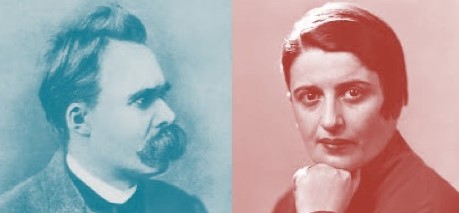
The abstract: “Philosophers Friedrich Nietzsche and Ayn Rand are often identified as strong critics of altruism and arch advocates of egoism. In this essay, Stephen Hicks argues that Nietzsche and Rand have much in common in their critiques of altruism but almost nothing in common in their views on egoism.”
My opening paragraph: “To what extent is Ayn Rand’s ethical theory Nietzschean? Three Friedrich Nietzsches are relevant to making that judgment. …”
The major sections of the article:
Part One: On Critiquing Altruism
Three Nietzsches and Ayn Rand
Some intellectuals on Nietzsche and Rand
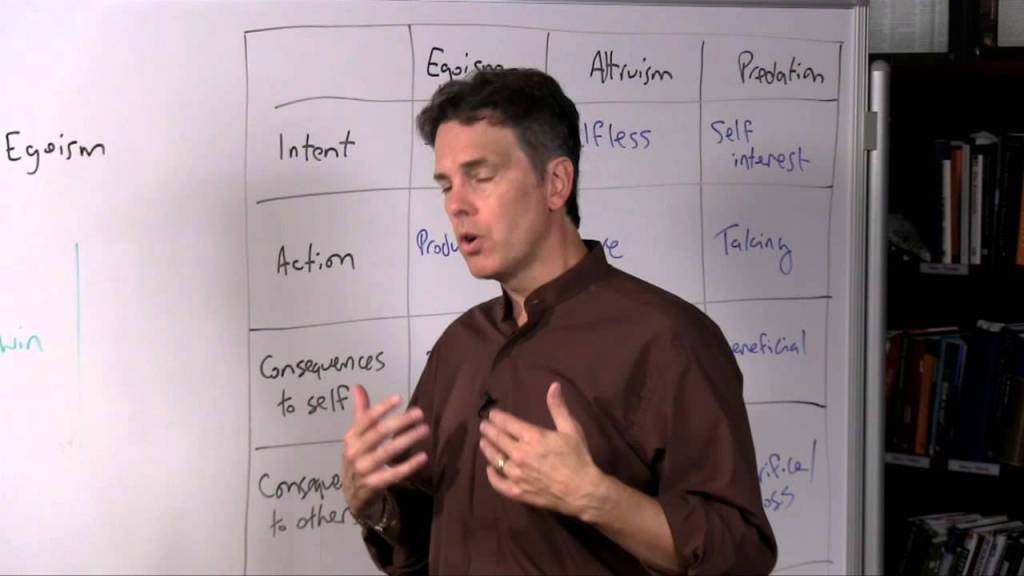
Egoism, altruism, and “selfishness”
A Nietzschean sketch God is dead
Nihilism’s symptoms
Two bio-psychological types
Psychology and morality
Genealogy
Comparing Nietzsche’s and Rand’s critiques of altruism
Rand’s break with Nietzsche’s critique
Part Two: On Egoism
Rand’s egoism
Nietzsche’s rhetoric and system
The major differences between Nietzsche and Rand Are individuals real?
Do individuals have free will?
What is the source of moral values?
How does the self identify its nature and values?
Are individual selves ends in themselves?
Are fundamental values universal?
Are the relations of individuals win/win or win/lose?
Rights, liberty, equality before the law?
Slavery and freedom, war and peace
Conclusion
Posted 1 year, 6 months ago at 8:04 am. Add a comment