While in Paris to film for the Artistic Genius documentary, I visited the Eiffel Tower near sunset.
This time I noticed a bust of Gustave Eiffel under the northwest leg of the tower. Portraits of great individuals are usually not made until they are old or even from memory after they are dead.

As a result, those of us in later generations have a harder time grasping how those individuals were in their prime — vigorous, purposeful, and vital.
Is this Leonardo? Is this Carnegie?
So I like very much this eternally-youthful bust of Eiffel.

(Click on image to enlarge.)
Posted 9 months, 3 weeks ago at 6:44 am. 1 comment
Shooting the last two days in Florence, where republican politics, relatively free markets and innovative business, relaxed religion, and humanistic philosophy laid the groundwork for the explosion of artistic creativity in the 1400s — Brunelleschi, Masaccio, Ghirlandaio, Leonardo, Botticelli, Michelangelo, Raphael, and the list goes on.
Awesome. Visual delights everywhere, a strong sense of living history, and food, food, food.
Tip for driving in Roma and Firenze: It’s a mindset thing — just out-crazy the Italian drivers, and you’ll be fine.
Posted 10 months, 1 week ago at 3:24 am. 2 comments
We are currently working on a new documentary with the working title Artistic Genius: When It Flourishes. The question I take up is why art flourishes so awesomely in some places and times — classical Athens,
Renaissance Florence, the Dutch Golden Age, nineteenth-century Paris — but is stagnant in others.
Some of our production team worked with me on Nietzsche and the Nazis, but we have several new members — and quintuple the budget. I will look forward to introducing the team and updating on progress in future posts.
For now, here is a statue of Rembrandt in his birth city of Leiden, Netherlands. Off to Haarlem and Amsterdam later today.
Posted 10 months, 2 weeks ago at 7:58 pm. 1 comment
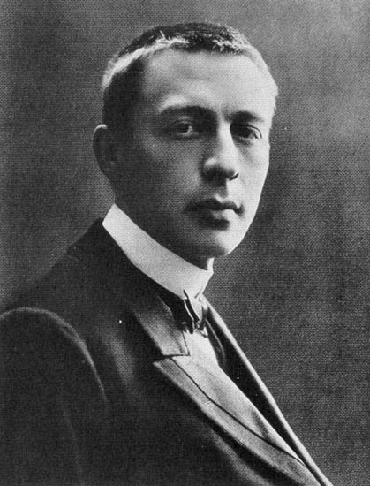
The great Rachmaninoff on what the creator needs and what this implies for others:
“A creator is a very limited person. Always he revolves around his own axis. There is nothing for him but his own creative work. I agree that the wife has to forget herself, her own personality. She must take upon herself all the physical care and material worries.
The only thing she should tell her husband is that he is a genius. Rubinstein was right when he said that a creator needed only three things—‘praise, praise, and praise.’ The most frequent mistake of the wives is that they take the creator for an ordinary man. There is not enough understanding. Take Tolstoy: if he had a stomach pain, he talked about it all day long. But the trouble was not in the stomach at all; it was in the fact that he could not work that day. This is what made him suffer. There is not enough understanding of what a creative artist needs. This is why Tolstoy was so miserable.”
Rachmaninoff says that the creator needs a partner who is only a combined devoted-servant-and-cheerleader. Why?
* Is it because extraordinary individuals operate on a level of emotional and intellectual focus and intensity that ordinary people cannot share, so the ordinaries must either submerge themselves into a supporting role or get out of the way?
* Is it because the time commitment of creativity leaves little-to-nothing for other life activities?
* Or is it that the creative genius does not transition well from creative work to other aspects of life — that is, he cannot be a multi-tasker?
Reminds of Nietzsche’s line — “A married philosopher belongs in comedy” — that it’s a joke to combine first-rate philosophy with the commitments of married life. [My reaction to that, as a married guy, has always been, #*@% you, Friedrich.]
And about the “praise, praise, and praise.” How could that have any meaning to the creator if it’s coming from someone who has forgotten her own self and personality?
Another implication of Rachmaninoff’s point seems to be that a creator could have no significant relationships in his life. What he says about wives also applies to friends, creative partners, and children. We all face trade-offs of time and energy, but I don’t see in principle why — with the right personal character and the right other people — one cannot combine creative work with great romance, great friendships, and great family life.
Further — that those relationships could enhance rather than detract from one’s creative work life. Difficult: yes. Impossible: no. And shouldn’t the truly selfish creator want the best of everything?
Related:
Geniuses and their followers.
Movement in-fighting and schisms.
How great artists become great.
More on how great artists become great.
Creative geniuses as selfish — Richard Wagner version.
Source: Sergei Bertensson and Jay Leyda’s Sergei Rachmaninoff: A Lifetime in Music (Indiana University Press, 2001), p. 288.
Posted 1 year, 1 month ago at 10:17 am. Add a comment