A strong observation from Numa Denis Fustel de Coulanges’s The Ancient City:
“It is a general fact, and almost without exception in the history of Greece and of Italy, that the tyrants sprang from the popular party, and had the aristocracy as enemies. ‘The mission of the tyrant,’ says Aristotle, ‘is to protect the people against the rich; he has always commenced by being a demagogue, and it is the essence of tyranny to oppose the aristocracy.’ ‘The means of arriving at tyranny,’ he also says, ‘is to gain the confidence of the multitude, and one does this by declaring himself the enemy of the rich. This was the course of Peisistratus at Athens, of Theagenes at Megara, and of Dionysius at Syracuse.’”
Setting aside any comparisons to contemporary politics, how well does Coulanges’s observation hold up historically? He mentions examples from Greece and Italy. Are the Jacobins of the French Revolution an example? Hitler and the National Socialists? Mao and the Communists? Counter-examples?
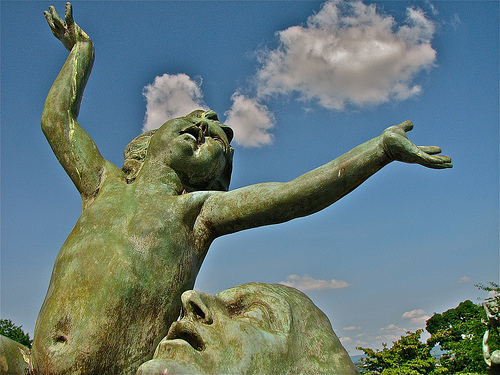
(Coulanges’s quotations from Aristotle are from Politics V.8, VIII.4, 5, and V. 4. The image is of statues of tyrannicides Harmodius and Aristogeiton, who killed Peisistratus’s son Hipparchus.)
Posted 2 days ago at 9:20 pm. Add a comment
When I was teaching out east some years ago, I noted a Philadelphia Inquirer piece on the Voluntary Human Extinction Movement. This organization, firmly in the grip of zero-sum anti-humanist environmentalism, was calling for the elimination of human beings by unspecified means.
I expect that VHEMT’s members are no longer with us, but somehow the desire to end the human species has survived and pops up in a Peter Singer piece at the New York Times site: “Should This Be the Last Generation?”
In the article, Princeton philosopher Singer asks us to consider sterilizing ourselves. Bringing no additional children into the world would improve things since (a) we are hurting the environment, and (b) life sucks anyways.
During his career, Peter Singer has always exhibited a great ability to take zero-sum thinking to its reductio ad absurdum limits. But since he accepts the premise firmly, he doesn’t see the absurdity as such (despite his tacked-on compromise conclusion in the NYT piece.)
Singer’s “life sucks” attitude is, as he points out, a re-statement of Arthur Schopenhauer’s strong pessimism. Reality, Schopenhauer wrote in The World as Will and Representation, is a “world of constantly needy creatures who continue for a time merely by devouring one another, pass their existence in anxiety and want, and often endure terrible affliction, until they fall at last into the arms of death” (p. 349). And more: “we have not to be pleased but rather sorry about the existence of the world, that its non-existence would be preferable to its existence” (p. 576). As for mankind: “nothing else can be stated as the aim of our existence except the knowledge that it would be better for us not to exist” (p. 605).
In his piece, Singer also mentions David Benatar, whom I discussed briefly two years ago in my “Worth Reading” for January 18, 2008:
‘A recent extreme anti-humanist manifesto published by Oxford University Press—David Benatar’s Better Never To Have Been: The Harm Of Coming Into Existence: “David Benatar argues that coming into existence is always a serious harm. Although the good things in one’s life make one’s life go better than it otherwise would have gone, one could not have been deprived by their absence if one had not existed. Those who never exist cannot be deprived. However, by coming into existence one does suffer quite serious harms that could not have befallen one had one not come into existence. … The author then argues for the ‘anti-natal’ view—that it is always wrong to have children—and he shows that combining the anti-natal view with common pro-choice views about foetal moral status yield a ‘pro-death’ view about abortion (at the earlier stages of gestation). Anti-natalism also implies that it would be better if humanity became extinct.”’
Philosophically, Singer’s thinking rests on three beliefs:
1. Human beings are net destroyers (rather than net creators).
2. Human beings experience life in net-negative terms (rather than net-positive).
3. Humans should be selfless and sacrifice the lesser value of their own lives for the greater value of other beings (rather than pursue happiness).
Premise one is the standard Malthusian premise that many environmentalists and other doomsters find so seductive; the antidote is Julian Simon’s great work. Premise three is a strong form of altruistic collectivism; the antidotes are the life-affirming philosophies, especially, in my judgment, those of Aristotle and Rand. And premise two is will-to-nothingness pessimism; but there is no known antidote once that poison has taken hold.
In his Lysis, Plato has Socrates say: “I think you’re right, Lysis, to say that if we were looking at things the right way, we wouldn’t be so far off course. Let’s not go in that direction any longer” (Lysis 213e).
Posted 1 month, 3 weeks ago at 2:39 pm. 20 comments
The Center for Ethics and Entrepreneurship has announced its four guest speakers for this semester:
Roberto Salinas Leon, Ph.D., on business, education, and philosophy in the US and Mexico.
William Kline, Ph.D., on David Hume’s ethics.
Jeffrey Orduno, J.D., on property rights and the law.
Douglas Rasmussen, Ph.D., on Aristotle and contemporary ethics.
Above is a jpeg version of the flyer. For the pdf, click here. CEE’s announcement is here. For more information, email Chris at CEE [at] CEE [dot] edu, or stay tuned for posts updating times and places.
Posted 6 months, 1 week ago at 12:15 pm. 1 comment
[This excerpt is from Chapter 2 of Explaining Postmodernism: Skepticism and Socialism from Rousseau to Foucault]
Why Kant is the turning point
Kant was the decisive break with the Enlightenment and the first major step toward postmodernism. Contrary to the Enlightenment account of reason, Kant held that the mind is not a response mechanism but a constitutive mechanism. He held that the mind—and not reality—sets the terms for knowledge. And he held that reality conforms to reason, not vice versa. In the history of philosophy, Kant marks a fundamental shift from objectivity as the standard to subjectivity as the standard.
Wait a minute, a defender of Kant may reply. Kant was hardly opposed to reason. After all, he favored rational consistency and he believed in universal principles. So what is anti-reason about that? The answer is that more fundamental to reason than consistency and universality is a connection to reality. Any thinker who concludes that in principle reason cannot know reality is not fundamentally an advocate of reason. That Kant was in favor of consistency and universality is of derivative and ultimately inconsequential significance. Consistency with no connection to reality is a game based on subjective rules. If the rules of the game have nothing to do with reality, then why should everyone play by the same rules? These were precisely the implications the postmodernists were to draw eventually.
Kant was thus different from previous skeptics and religious apologists. Many earlier skeptics had denied that we can know anything, and many earlier religious apologists had subordinated reason to faith. But earlier skeptics had never been as sweeping in their conclusions. Earlier skeptics would identify particular cognitive operations and raise problems for them. Maybe a given experience is a perceptual illusion—thus undermining our confidence in our perceptual faculties; or maybe it is a dream—thus undermining our confidence in be distinguishing truth from fantasy; or maybe induction is only probabilistic—thus undermining our confidence in our generalizations; and so on. But the conclusion of those skeptical arguments would be merely that we cannot be sure that we are right about the way reality is. We might be, but we cannot guarantee it, the skeptics would conclude. Kant’s point was deeper, arguing that in principle any conclusion reached by any of our faculties must necessarily not be about reality. Any form of cognition, because it must operate a certain way, cannot put us in contact with reality. On principle, because our minds’ faculties are structured in a certain way, we cannot say what reality is. We can only say how our minds have structured the subjective reality we perceive. This thesis had been implicit in the works of some earlier thinkers, including Aristotle’s, but Kant made it explicit and drew the conclusion systematically.
Kant is a landmark in a second respect. Earlier skeptics had, despite their negative conclusions, continued to conceive of truth as correspondence to reality. Kant went a step further and redefined truth on subjective grounds. Given his premises, this makes perfect sense. Truth is an epistemological concept. But if our minds are in principle disconnected from reality, then to speak of truth as an external relationship between mind and reality is nonsense. Truth must be solely an internal relationship of consistency.
With Kant, then, external reality thus drops almost totally out of the picture, and we are trapped inescapably in subjectivity—and that is why Kant is a landmark. Once reason is in principle severed from reality, one then enters a different philosophical universe altogether.
This interpretive point about Kant is crucial and controversial. An analogy may help drive the point home. Suppose a thinker argued the following: “I am an advocate of freedom for women. Options and the power to choose among them are crucial to our human dignity. And I am wholeheartedly an advocate of women’s human dignity. But we must understand that a scope of a woman’s choice is confined to the kitchen. Beyond the kitchen’s door she must not attempt to exercise choice. Within the kitchen, however, she has a whole feast of choices—whether to cook or clean, whether to cook rice or potatoes, whether to decorate in blue or yellow. She is sovereign and autonomous. And the mark of a good woman is a well-organized and tidy kitchen.” No one would mistake such a thinker for an advocate of woman’s freedom. Anyone would point out that there is a whole world beyond the kitchen and that freedom is essentially about exercising choice about defining and creating one’s place in the world as a whole. The key point about Kant, to draw the analogy crudely, is that he prohibits knowledge of anything outside our skulls. He gives reason lots to do within the skull, and he does advocate a well-organized and tidy mind, but this hardly makes him a champion of reason. The point for any advocate of reason is that there is a whole world outside our skulls, and reason is essentially about knowing it.
Kant’s contemporary Moses Mendelssohn was thus prescient in identifying Kant as “the all-destroyer.”[21] Kant did not take all of the steps down to postmodernism, but he did take the decisive one. Of the five major features of Enlightenment reason—objectivity, competence, autonomy, universality, and being an individual faculty—Kant rejects objectivity. Once reason is so severed from reality, the rest is details—details that are worked out over the next two centuries. By the time we get to the postmodernist account, reason is seen not only as subjective, but also as incompetent, highly contingent, relative, and collective. Between Kant and the postmodernists comes the successive abandonment of the rest of reason’s features.
References
[21] Quoted in Beck 1969, 337.
Bibliography
[The chapter from which this section of Stephen Hicks's Explaining Postmodernism (Scholargy Publishing, 2004) is excerpted can be downloaded as a PDF at the Explaining Postmodernism page. The full book is also available at Amazon.com.]
Posted 6 months, 1 week ago at 3:46 pm. Add a comment
I will be giving a talk next week to a graduate philosophy class at Bowling Green State University in Ohio. The theme of my talk is: What Philosophers Need to Know about Economics.
Over the past generation BGSU has developed one of the country’s strongest programs in applied ethics and political philosophy, so it will be an honor as well as a pleasure. Thanks to Professor Fred Miller and Professor Pam Phillips, the course’s instructors, for the invitation.
I will be discussing philosophy’s contributions to the debates over economics as a social science. What is a science? Since economics is about valuing, how does one (or can one) bridge the is-ought gap in ethics? Since individual economic agents can be irrational in their values, how epistemologically can there be a science involving such agents? Great issues that take us to landmark influential philosophers in conflict with each other — e.g., Hume versus Aristotle, the Logical Positivists versus the Postmodernists — and landmark influential economists in conflict with each other — e.g., the neoclassicals versus the Austrians.
Posted 6 months, 3 weeks ago at 10:44 pm. 4 comments
One of my all-time favorite passages from Aristotle is in his Parts of Animals (Book 1, Chapter 5). After discussing some introductory taxonomic and methodological issues in the animal sciences, Aristotle expresses his wonder and fascination with all aspects of nature, great and small, beautiful to the eye and not:
“Having already treated of the celestial world, as far as our conjectures could reach, we proceed to treat of animals, without omitting, to the best of our ability, any member of the kingdom, however ignoble. For if some have no graces to charm the sense, yet even these, by disclosing to intellectual perception the artistic spirit that designed them, give immense pleasure to all who can trace links of causation, and are inclined to philosophy. Indeed, it would be strange if mimic representations of them were attractive, because they disclose the mimetic skill of the painter or sculptor, and the original realities themselves were not more interesting, to all at any rate who have eyes to discern the reasons that determined their formation. We therefore must not recoil with childish aversion from the examination of the humbler animals. Every realm of nature is marvellous: and as Heraclitus, when the strangers who came to visit him found him warming himself at the furnace in the kitchen and hesitated to go in, reported to have bidden them not to be afraid to enter, as even in that kitchen divinities were present, so we should venture on the study of every kind of animal without distaste; for each and all will reveal to us something natural and something beautiful. Absence of haphazard and conduciveness of everything to an end are to be found in Nature’s works in the highest degree, and the resultant end of her generations and combinations is a form of the beautiful” (645a).
A passionate quest for passionless truth indeed.
Aristotle’s enchantment with the world reminds me of this sentiment expressed 2,200 years later by John Stuart Mill:
“A cultivated mind — I do not mean that of a philosopher, but any mind to which the fountains of knowledge have been opened, and which has be taught, in any tolerable degree, to exercise its faculties — finds sources of inexhaustible interest in all that surrounds it: in the objects of nature, the achievements of art, the imaginations of poetry, the incidents of history, the ways of mankind, past and present, and their prospects for the future” (Utilitarianism, Chapter 2).
Some things never change, and I love it.
Posted 10 months, 4 weeks ago at 8:04 pm. 3 comments


I am organizing a session for the Association for Private Enterprise Education conference to be held April 11-13, 2010 in Las Vegas, Nevada. The theme is “Reason in Hayek and Rand.”
Here we have two giants of twentieth-century thought, but few comparative studies have been done. So as a start I have chosen Reason as a focusing theme and have solicited papers from several scholars on topics such as the following:
* How does Friedrich Hayek’s account of reason compare to Ayn Rand’s?
* Hayek is more focused on reason’s role in social causation while Rand is more focused on reason as an individual phenomenon. True?
* Is it accurate to say that Hayek is a sociologist of reason while Rand is a philosopher of reason?
* Hayek is an empiricist, broadly speaking, as is Rand, but Hayek’s reason is more Humean while Rand’s is more Aristotelian. True?
* Hayek has been interpreted as being a skeptic about reason and as tending to postmodernism (e.g., by Theodore Burczak). True? And if so, does this put him in direct contrast to Rand, who is a strong anti-skeptic?
* Hayek sometimes seems ambivalent about the relation between reason-based discoveries of social science and normative issues. Rand tightly integrates reason’s descriptive and normative functions. Issue here?
* On socialism: Hayek argues a reason-as-fatal-conceit thesis, while Rand places the blame primarily on an ultimately irrational altruism. Are these interpretations complementary or in conflict?
When the session’s panel is finalized, I’ll post it.
Posted 10 months, 4 weeks ago at 8:50 am. 2 comments
My fourth and final contribution to contest, my earlier three being from John Stuart Mill, Immanuel Kant, and Aristotle.
I am surprised that we have no entries from Hegel, Fichte, or Heidegger, noted for their why-say-it-in-eight-words-when-sixty-are-available tendencies.
But to my knowledge, the longest sentence written by a philosopher is the following 309-word original from the pen of John Locke:
“It having been shewn in the foregoing discourse,
1. That Adam had not, either by natural right of fatherhood, or by positive donation from God, any such authority over his children, or dominion over the world, as is pretended:
2. That if he had, his heirs, yet, had no right to it:
3. That if his heirs had, there being no law of nature nor positive law of God that determines which is the right heir in all cases that may arise, the right of succession, and consequently of bearing rule, could not have been certainly determined:
4. That if even that had been determined, yet the knowledge of which is the eldest line of Adam’s posterity, being so long since utterly lost, that in the races of mankind and families of the world, there remains not to one above another, the least pretence to be the eldest house, and to have the right of inheritance:
All these premises having, as I think, been clearly made out, it is impossible that the rulers now on earth should make any benefit, or derive any the least shadow of authority from that, which is held to be the fountain of all power, Adam’s private dominion and paternal jurisdiction; so that he that will not give just occasion to think that all government in the world is the product only of force and violence, and that men live together by no other rules but that of beasts, where the strongest carries it, and so lay a foundation for perpetual disorder and mischief, tumult, sedition and rebellion, (things that the followers of that hypothesis so loudly cry out against) must of necessity find out another rise of government, another original of political power, and another way of designing and knowing the persons that have it, than what Sir Robert Filmer hath taught us.”
That is the opening sentence of Locke’s Second Treatise of Government. It makes one yearn for more, which one can find here.
I am open to argument about the archaic punctuation. If we take the end of Locke’s fourth numbered point as a full stop, then the passage breaks down to one 156-word chunk and another 153-word chunk.
But absent further argument and contributions, I declare Locke the winner.
(Subject to further discoveries that would bump him down in the rankings.)
Posted 1 year ago at 12:35 pm. Add a comment