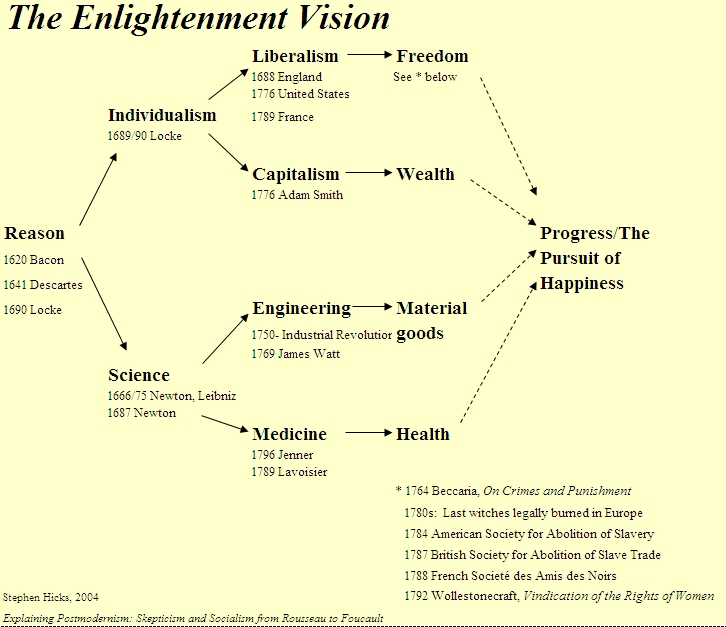
The Enlightenment of the long 18th century was an era of awesome intellectual and cultural transformation.

This Enlightenment Vision flowchart is pitched at a high level of abstraction, showing schematically how the philosophical revolution of the 17th century led to the 18th-century revolutions in science, technology, politics, and economics — which in turn led to the dramatic increases in health, wealth, freedom, and goods in the 19th century.
To put it another way, the chronology shows how the ideas played out as philosophy, then as an intellectual movement, then as activism, then as the working technology of culture.
I first develop the chart for my courses in philosophy and intellectual history and published a version of it in Explaining Postmodernism. It’s posted here as a PDF, as a JPEG image, or as an Excel file, in case you’d like to adapt it for your own purposes.
(Thanks to Brian Schwartz for prompting this update.)
Posted 3 months, 3 weeks ago at 8:42 pm. 4 comments
While the world watched France’s revolution, an equally important cultural phenomenon was occurring across the Rhine:
“In the year 1789 … nothing else was talked of in Germany but the philosophy of Kant, about which were poured forth in abundance commentaries, chrestomathies, interpretations, estimates, apologies, and so forth.” That’s Heinrich Heine, who also wrote, “Our German philosophy is really but the dream of the French Revolution … Kant is our Robespierre.”
More soberly, German historian Friedrich Meinecke connected the philosophical “dream” to politics this way: “In the 1780s the critique of pure reason had conquered all minds, but in the following decade Kant’s thoughts on practical reason became the catalyst for a genuine social movement” (The Age of German Liberation, 25).
Meanwhile, across the Atlantic, a very different kind of intellectual and political revolution had come to fruition in the 1780s.
Kant/Robespierre or Locke/Washington. It’s still our choice.
Posted 1 year, 11 months ago at 7:13 pm. Add a comment
[This is Section 20 of Nietzsche and the Nazis.]
20. The question of Nazism’s philosophical roots
We do not do ourselves any favors by not understanding Nazism thoroughly or by being satisfied with superficial explanations. It took a world war to stop National Socialism in the twentieth century. War is brute force. Brute force rarely changes anyone’s minds about anything, and it alone does not destroy the underlying causes that motivate conflict. To use a crude analogy: If two neighbors are having an ongoing argument about a series of issues, and one neighbor hits the other and knocks him unconscious—that ends the argument but it does not solve their problems. The source of their argument is still there and it will re-surface.
The same holds for the underlying causes of National Socialism and its differences with the liberal democracies. The liberal democracies were able to knock out the Nazis in World War II, though it was a close call—but the underlying arguments are still with us.
The differences between National Socialism and liberal democracies are profound and involve entirely different philosophies of life. National Socialism was the product of a well-thought-out philosophy of life, the main elements of which were originated, crafted, and argued by philosophers and other intellectuals across many generations.
The Nazi intellectuals were not lightweights, and we run the risk of underestimating our enemy if we dismiss their ideology as attractive only to a few cranky weirdos.[43] If your enemy has a machine gun but you believe he only has a pea shooter, then you are setting yourself up for failure. And if we remind ourselves of the list of very heavyweight intellectuals who supported Nazism—Nobel Prize winners, outstanding philosophers and brilliant legal thinkers—then it is clear that these were no pea-shooters and that we need heavyweight intellectual ammunition to defend ourselves.
In the case of other major historical revolutions, we are more familiar with seeing the significance of philosophy. When we think for example of the causes of the Communist Revolutions in Russia and China, we naturally think back to the philosopher Karl Marx. When we think of the causes of the French Revolution, we think back to Jean-Jacques Rousseau. When we think of the causes of the American Revolution, we naturally think back to the philosopher John Locke. The same holds the causes of National Socialism—although since the Nazi regime went so horribly wrong, there is perhaps some reluctance to name names. Yet naming names is sometimes crucial if we are going to get to the historical heart of the matter. What philosophers can we cite in the case of the Nazis? Several names are candidates: Georg Hegel, Johann Fichte, even elements from Karl Marx.
But in connection with the Nazis, perhaps the biggest and the most controversial name regularly mentioned is that of Friedrich Nietzsche. The Nazis often cited Nietzsche as one of their philosophical precursors, and even though Nietzsche died thirty-three years before the Nazis came to power, references to Nietzsche crop up regularly in Nazi writings and activities. In philosopher Heidegger’s lectures, for example, “Nietzsche was presented as the Nazi philosopher.”[44]
In his study, Adolf Hitler had a bust of Friedrich Nietzsche. In 1935, Hitler attended and participated in the funeral of Nietzsche’s sister Elisabeth. In 1938, the Nazis built a monument to Nietzsche. In 1943, Hitler gave a set of Nietzsche’s writings as a gift to fellow dictator Benito Mussolini.[45]
Hitler’s propaganda minister, Joseph Goebbels, was also a great admirer of Friedrich Nietzsche. In his semi-autobiographical novel, Goebbels has the title character Michael die in a mining accident—afterward three books are found among his belongings: the Bible, Goethe’s Faust, and Nietzsche’s Thus Spake Zarathustra.
So who was Friedrich Nietzsche?
References
[43] Recall Albert Speer on “the event that led me to [Hitler]”—a speech Hitler gave to the College of Engineering in Berlin: Speer expected it to be “a bombastic harangue” but it turned out to be a “reasoned lecture” (quoted in Orlow 1969, p. 199).
[44] Rohkrämer 2005, p. 181.
[45] During WWI, the German government printed 150,000 copies of Nietzsche’s Thus Spake Zarathustra and gave them to soldiers along with a copy of the Bible.
[Bibliography.]
[Return to the Nietzsche and the Nazis page. Go to the StephenHicks.org main page.]
Posted 2 years, 1 month ago at 3:34 pm. Add a comment
The Enlightenment of the long 18th century was an era of awesome intellectual and cultural transformation.
My Enlightenment Vision flowchart [pdf] is pitched at a high level of abstraction, showing schematically how the philosophical revolution of the 17th century led to the 18th-century revolutions in science, technology, politics, and economics — which in turn led to the dramatic increase in health, wealth, freedom, and goods in the 19th century.
To put it another way, the chronology shows how the ideas played out as philosophy, then as an intellectual movement, then as activism, then as the working technology of culture.
I use the chart in my classes and published a version of it in my 2004 Explaining Postmodernism. It’s here as a PDF and as an Excel file, in case you’d like to adapt it for your own purposes.
[This is an excerpt from Stephen Hicks's Explaining Postmodernism: Skepticism and Socialism from Rousseau to Foucault (Scholargy Publishing, 2004, 2011). The full book is available in hardcover or e-book at Amazon.com. See also the Explaining Postmodernism page.]
Posted 2 years, 4 months ago at 6:28 pm. Add a comment