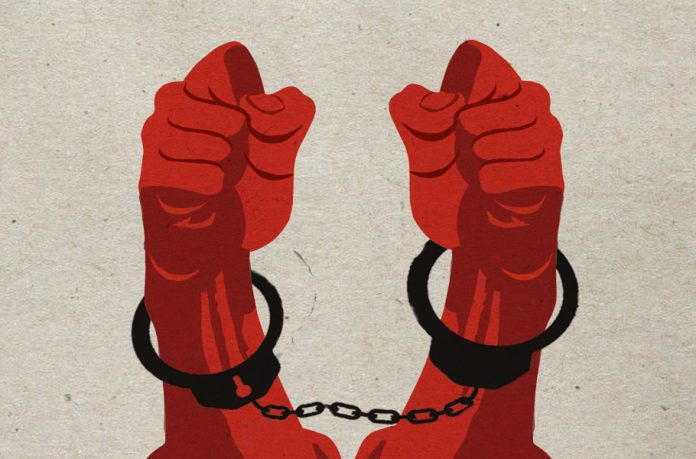
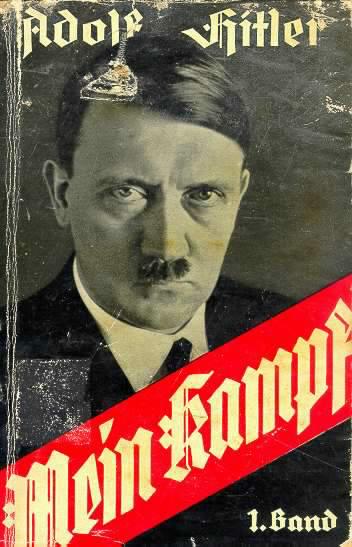
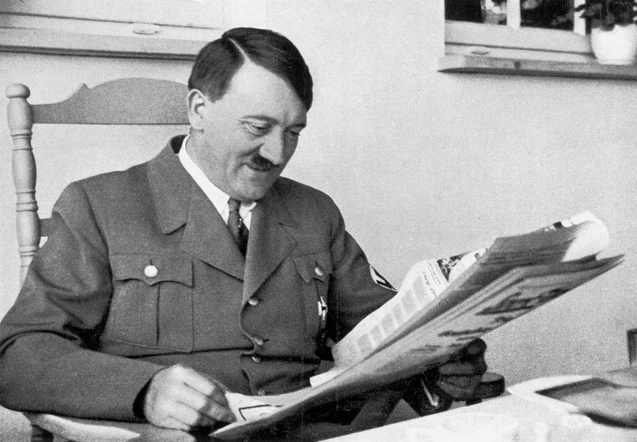
Baader-Meinhof was a far Left terrorist group, and one of the most violent, killing dozens and maiming more during the 1970s. Its “official” name was Rote Armee Fraktion (”Red Army Faction”). The logo shows a nice big socialist red star with a Heckler Koch submachine gun.
The group’s two most prominent members were Andreas Baader and Ulrike Meinhof. Here is one of Meinhof’s explanations:
“Auschwitz meant that six million Jews were killed, and thrown on the waste-heap of Europe, for what they were: money Jews. Finance capital and the banks, the hard core of the system of imperialism and capitalism, had turned the hatred of men against money and exploitation, and against the Jews … Anti-Semitism is really a hatred of capitalism.” [Source.]
Which is of course right out of Karl Marx: “What is the profane basis of Judaism? Practical need, self-interest. What is the worldly cult of the Jew? Huckstering. What is his worldly god? Money. Very well: then in emancipating itself from huckstering and money, and thus from real and practical Judaism, our age would emancipate itself.
“As soon as society succeeds in abolishing the empirical essence of Judaism—huckstering and its conditions—the Jew becomes impossible … The social emancipation of the Jew is the emancipation of society from Judaism.” [Source: “On the Jewish Question” (1843), in The Marx-Engels Reader, pp. 48, 52.]
Which is what Hitler agreed with: “Today I will once more be a prophet. If the international Jewish financiers, inside and outside Europe, succeed in plunging the nations once more into a world war, then the result will not be the Bolshevisation of the earth, and thus the victory of Jewry, but the annihilation of the Jewish race in Europe!” [Source: Hitler, speaking in the Reichstag on January 30, 1939.]
As did Goebbels, in speaking of “the money pigs of capitalist democracy”: “Money has made slaves of us.” “Money is the curse of mankind. It smothers the seed of everything great and good. Every penny is sticky with sweat and blood.” [Sources: Goebbels, 1929, quoted in Orlow 1969, p. 87 and Goebbels 1929, quoted in Mosse ed., 1966, p. 107.]
[Bonus question: Who said this?
“The worker in a capitalist state—and that is his deepest misfortune—is no longer a living human being, a creator, a maker. He has become a machine. A number, a cog in the machine without sense or understanding. He is alienated from what he produces.”
Answer: Joseph Goebbels, in his 1932 “Those Damned Nazis” pamphlet.]

Related post: Heidegger, anti-humanism, and the Left
Posted 3 days, 20 hours ago at 4:08 pm. 1 comment
[This is Section 36 of Nietzsche and the Nazis.]
36. Instinct, passion, and anti-reason
Hitler was fond of saying, in private, “What luck that men do not think.”
Another significant point of agreement exists between Nietzsche and the Nazis: Both agree that the great conflicts will not be solved rationally, through the processes of discussion, argument, persuasion, or diplomacy. Both Nietzsche and the Nazis are irrationalists in their view of human psychology—and this has important social and political implications.
Think about democracy for a moment. In particular, think about how much confidence in the power of reason that democracy requires. Democracy is a matter of decentralizing political power to individuals by, for example, giving each individual a vote. The assumption of democracy is that individuals have the ability to weigh and judge important matters and cast a responsible vote. The expectation is that members of democracies will have ongoing discussions and arguments about all sorts of issues, and that they will be able to assess the evidence, the arguments and counter-arguments. And they will be able to learn from their mistakes and, when appropriate, change their votes the next time around.
It is not an accident that neither Nietzsche nor the Nazis were advocates of either democracy or reason.
Hitler considered a highly-developed intellect to be a weakness and too much reliance on reason to be a sickness. Germany’s recent problems, he believed, stemmed from too much thinking. “The intellect has grown autocratic, and has become a disease of life.” What Germany required was passion, a storm of emotion arising from deeply rooted instincts and drives: “Only a storm of glowing passion can turn the destinies of nations, but this passion can only be roused by a man who carries it within himself.”[119] Consequently, German training and propaganda were not directed toward presenting facts and arguments but rather to arousing the passions of the masses. Reason, logic, and objectivity were beside the point. “We are not objective, we are German,” said Hans Schemm, the first Nazi Minister of Culture.[120]
Here again there is an important connection to Nietzsche. Nietzsche too sees an opposition between conscious reason and unconscious instinct, and he disparages those who stress rationality—those who engage in what he calls the “ridiculous overestimation and misunderstanding of consciousness.”[121] In his own words, it is “‘Rationality’ against instinct,”[122] and he believes that rationality is the least useful guiding power humans possess. Humans came out of a long evolutionary line that relied on drives and instincts—and those drives and instincts served us well for millennia. Yet men eventually became settled, tamed, and civilized, and they lost something crucial:
“[I]n this new world they no longer possessed their former guides, their regulating, unconscious and infallible drives: they were reduced to thinking, inferring, reckoning, co-ordinating cause and effect, these unfortunate creatures; they were reduced to their ‘consciousness,’ their weakest and most fallible organ!”[123]
Note that Nietzsche says our unconscious drives are infallible, if only we can find them within ourselves again. It is our strongest, most assertive unconscious instinct that we should let rule our lives: “‘instinct’ is of all the kinds of intelligence that have been discovered so far—the most intelligent.”
And on this score, Nietzsche and the Nazis are in agreement: Both are fundamentally irrationalists—they do not think much of the power of reason, and they urge themselves and others to let their strongest passions and instincts well up within them and be released upon the world.
References
[119] Hitler, quoted in Langer.
[120] Schemm, quoted in Mosse 1966 xxxi.
[121] GS 11.
[122] EH: “The Birth of Tragedy” 1.
[123] GM II:16.
[124] BGE 218.
[Bibliography]
[This post can also be downloaded as a PDF at the Nietzsche and the Nazis page.]
Posted 2 weeks, 6 days ago at 2:34 pm. 1 comment
[This is Section 34 of Nietzsche and the Nazis.]
Part 7. Nietzsche as a Proto-Nazi
34. Anti-individualism and collectivism
We know that the National Socialists were thoroughly collectivistic and strongly anti-individualistic. For them the relevant groups were the Germanic Aryans—and all the others. Individuals were defined by their group identity, and individuals were seen only as vehicles through which the groups achieved their interests. The Nazis rejected the Western liberal idea that individuals are ends in themselves: to the Nazis individuals were merely servants of the groups to which they belong.
The anti-individualism of the Nazis was most blatant in their treatment of Jews. They did not see Jews as individuals with moral significance and rights—rather they saw members of a group they wished to destroy. This meant, as a matter of policy, that the Nazis were uncaring about the lives of individuals and were willing to kill as many individuals as was necessary to achieve their group’s advantage.
Even within their own group, the Nazis did not see Aryan/Germans fundamentally as individuals. They saw them as members of the Volk, the German people, the group to which they owed service, obedience, and even their lives.
Nietzsche has a reputation for being an individualist. There certainly are individualist elements in Nietzsche’s philosophy, but in my judgment his reputation for individualism is often much overstated.
When we speak of philosophies as being individualist or collectivist, three key points are at issue.
First, we ask: Do individuals shape their own identities—or are their identities created by forces beyond their control? For example, do individuals have the capacity to decide their own beliefs and form their own characters—or are individuals molded and shaped primarily by their biological inheritances or culturally by the groups they are born into and raised by?
Second, we ask: Are individuals ends in themselves, with their own lives and purposes to pursue—or do individuals exist for the sake of something beyond themselves to which they are expected to subordinate their interests?
Third, we ask: Do the decisive events in human life and history occur because individuals, generally exceptional individuals, make them happen—or are the decisive events of history a matter of collective action or larger forces at work?
Let us take the first issue—whether individuals shape themselves significantly or whether they are the product of forces beyond their control. Only in an attenuated way does Nietzsche believe that individuals shape their own characters and destiny—to a great extent he is determinist, believing that individuals are a product of their biological heritage. As he puts it in Beyond Good and Evil, “One cannot erase from the soul of a human being what his ancestors liked most to do and did most constantly.”[107] Any given individual’s thoughts, feelings, and actions, are an expression of an underlying set of traits that the individual inherited. Whether one is a sheep or a wolf is a matter of biology—one does not choose or shape oneself significantly—so to that extent it makes no sense to hold individuals responsible for who they are and what they become.[108]
What about the second issue—does Nietzsche believe that individuals are ends in themselves, that they exist for their own sake? Emphatically not. Here I think many casual readings of Nietzsche get him dead wrong. Take an initial obvious point: Nietzsche has nothing but contempt for the vast majority of the population, believing them to be sheep and a disgrace to the dignity of the human species. Their individual lives have no value in themselves. This is Nietzsche’s point in the following quotation, in which he denies explicitly that his philosophy is individualistic: “My philosophy aims at ordering of rank not at an individualistic morality.”[109] Nietzsche believes that most individuals have no right to exist and—more brutally—he asserts that if they were sacrificed or slaughtered that would be an improvement. In Nietzsche’s own words: “mankind in the mass sacrificed to the prosperity of a single stronger species of man—that would be an advance.”[110] And again: “One must learn from war: one must learn to sacrifice many and to take one’s cause seriously enough not to spare men.”[111] It is hard to see as an individualist anyone who sees no value in the lives of the vast majority of individuals. And it is hard to see as an individualist someone who would sacrifice those individuals in the name of improving the species. Improving the species is a collectivist goal, and measuring the value of individuals in terms of their value to the species and sacrificing those who do not measure up—that is textbook collectivism.
This connects directly to the value Nietzsche sees in the few great individuals who crop up in each generation. It is his powerfully poetic rhetoric in speaking of those exceptional individuals that gives Nietzsche his reputation for individualism. But it is important to note that Nietzsche does not see even those exceptional individuals as ends in themselves—and he does not exempt them from the sacrifice either. The point of becoming exceptional is not to advance one’s own life but to improve the human species—in fact to get beyond the human species to a higher species-type: the overman. As Nietzsche says repeatedly, “Not ‘mankind’ but overman is the goal!”[112] Nietzsche’s goal is a collectivist one—to bring about a new, future, higher species of man—overman. This is the significance of his exhortations about the Übermensch, the overman, the superman.
So it seems that for Nietzsche none of us, whether weak or strong, exist for our own sakes. In direct contrast to individualists who believe that individuals’ lives are their own to find and create value within, Nietzsche’s belief is that our lives have value only to the extent we fulfill a goal beyond our lives—the creation of a stronger species. And on that general collectivist end, Nietzsche has an important point in common with the Nazis.
There is also the third sub-issue of individualism—whether the decisive events in human life and history occur because individuals, generally exceptional individuals, make them happen, or whether individuals are pawns of greater historical forces. Here the Nazis’ theory and practice were a combination of both. They believed in and utilized mass-movement politics, seeing their political movement as the vehicle through which a powerful cultural force—the German Volk—was asserting its historical destiny. At the same time, the Nazis held that those powerful historical forces singled out some special individuals to perform special tasks and that destiny spoke through those special individuals. This, at any rate, was Hitler’s firm belief when he made statements such as the following: “I carry out the commands that Providence has laid upon me”; and “No power on earth can shake the German Reich now, Divine Providence has willed it that I carry through the fulfillment of the Germanic task.”[113]
In invoking Divine Providence, Hitler is drawing upon a long philosophical tradition that goes back most famously to the German philosopher Georg Hegel, with his World-Historical Individuals—those individuals such as Julius Caesar and Napoleon Bonaparte, who, on Hegel’s view, were vehicles through which the Spiritual forces of history operated. That tradition goes back even further in religious interpretations of history.
Think, for example, of religious prophets. Prophets are special individuals within a religious tradition. The prophet, though, is not special as an individual—he is not an individual who has acquired his powers through his own efforts and who has created his own new and unique vision. Rather the prophet is special only because God has chosen him and because God is speaking through him. The prophet is totally a tool of God—his power comes from God and he is a mouthpiece through which God speaks his message. He is a localized vehicle through which the real force—namely, God—works.
Now let us return to Nietzsche. Nietzsche is an atheist, yet he offers a secular version of the same theory.
Nietzsche’s power force is not religious or spiritual force, but a biological one. His great men—prophets like the Zarathustras who may be among us and those who are to come—are special individuals in whom powerful evolutionary forces have converged to create something remarkable. And those powerful evolutionary forces are working through those Zarathustras to achieve something even more remarkable—the overman. Such exceptional individuals do not develop and use power; power develops and uses those individuals. Individuals are only the tools, the vehicles. This is what Nietzsche is getting at when he says that every “living creature values many things higher than life itself; yet out of this evaluation itself speaks—the will to power.”[114]
Note what Nietzsche is saying the real causal power is: The will to power works through those individuals; it is not that those individuals develop and use power.
There is legitimate controversy among scholars over this interpretation of Nietzsche, but to the extent this interpretation is true it does undermine Nietzsche’s reputation as an individualist and strengthens the claim the Nazis have on him as a philosophical forerunner.
References
[107] BGE 264.
[108] “There is only aristocracy of birth, only aristocracy of blood” (WP 942).
[109] WP 287. Morality is a social product: it arises “when a greater individual or a collective-individual, for example the society, the state, subjugates all other single ones … and orders them into a unit” (HH 1.99).
[110] GM II:12.
[111] WP 982.
[112] WP 1001.
[113] Hitler, quoted in Langer.
[114] Z 2:12.
[Bibliography]
http://www.stephenhicks.org/2009/10/26/bibliography-nietzsche-and-the-nazis/
[This post can also be downloaded as a PDF at the Nietzsche and the Nazis page.]
Posted 3 weeks, 6 days ago at 1:40 pm. 3 comments
[This is Section 32 of Nietzsche and the Nazis.]
32. On Judaism and Christianity: opposite or identical?
One more key difference between Nietzsche and the Nazis is important, and that is their views on Christianity. Nietzsche consistently states that Judaism and Christianity are allies, both stemming from the same source, both advocating a religious ethic that puts the weak, the sick, and the humble first. As with Judaism, Christian morality is a slave morality.
Christianity, he writes, is “a rebellion of everything that crawls on the ground against that which has height.”[100]
The Christians, he writes, “did not know how to love their god except by crucifying man.”[101] And for that great crime against humanity, Nietzsche says: “I condemn Christianity. I raise against the Christian church the most terrible of all accusations that any accuser ever uttered. It is to me the highest of all conceivable corruptions.”[102]
So Christianity does not escape Nietzsche’s wrath, just as the slave morality of the Jews did not escape his wrath—and for the same reason: Christianity is an extension and purification of moral themes first developed within Judaism. In Nietzsche’s own words: “In Christianity, all of Judaism . . . attains its ultimate mastery as the art of lying in a holy manner. The Christian, the ultima ratio of the lie, is the Jew once more—even three times more.”[103]
This identification of Christianity with Judaism also separates Nietzsche from the Nazis, for the Nazis took great pains to distinguish the Jews and the Christians, condemning Judaism and embracing a generic type of Christianity.
Early in the Nazi Party’s history, in its founding document, the 1920 Program, point 24 states the following: “The party, as such, stands for positive Christianity, without, however, allying itself to any particular denomination. It combats the Jewish-materialistic spirit.”
The use of Christian themes and imagery was prominent in Nazi propaganda throughout the 1920s.
In Joseph Goebbels’s semi-autobiographical novel, the main character Michael is portrayed as a hybrid Christ-figure and German martyr. And in a 1935 interview, Goebbels was so concerned to separate Christianity from Judaism that he went as far as to deny that Jesus was a Jew.
Adolf Hitler argued that the Christians and Jews were fundamentally opposed religions[104] and himself sounded Christian moral themes explicitly in public pronouncements such as this one: “When I came to Berlin a few weeks ago … the luxury, the perversion, the iniquity, the wanton display, and the Jewish materialism disgusted me so thoroughly, that I was almost beside myself. I nearly imagined myself to be Jesus Christ when He came to His Father’s temple and found it taken by the money-changers. I can well imagine how He felt when He seized a whip and scourged them out.”[105]
References
[100] A 43.
[101] Z 2: “On Priests.”
[102] A 62.
[103] A 44.
[104] Hitler 1925, 307.
[105] Hitler, quoted in Langer, (viewed July 25, 2006). Hitler also claimed: “By warding off the Jews, I struggle for the work of the Lord” (quoted in Lilla 1997, p. 38).
[Bibliography]
[This post can also be downloaded as a PDF at the Nietzsche and the Nazis page.]
Posted 1 month ago at 8:06 pm. 2 comments
[This is Section 27 of Nietzsche and the Nazis.]
Part 6. Nietzsche against the Nazis
27. Five differences
Now we can ask the big pay-off question. After surveying National Socialist theory and practice and engaging with Friedrich Nietzsche’s philosophy, we can ask: How much do Nietzsche and the Nazis have in common? Or to put it another way: To what extent were the Nazis justified in seeing Nietzsche as a precursor of their movement?
We know that Adolf Hitler, Joseph Goebbels, and most of the major intellectuals of National Socialism were admirers of Nietzsche’s philosophy. They read him avidly during their formative years, recommended him to their peers, and incorporated themes and sayings from Nietzsche into their own writings, speeches, and policies. To what extent were they accurate and justified in doing so?
In my judgment on this complicated question, a split decision is called for. In several very important respects, the Nazis were perfectly justified in seeing Nietzsche as a forerunner and as an intellectual ally. And in several important respects, Nietzsche would properly have been horrified at the misuse of his philosophy by the Nazis.
Let us start with the key differences between Nietzsche and the Nazis. Here I want to focus on five important points.
[This post can also be downloaded as a PDF at the Nietzsche and the Nazis page.]
Posted 1 month, 2 weeks ago at 8:31 am. Add a comment
[This is Section 20 of Nietzsche and the Nazis.]
20. The question of Nazism’s philosophical roots
We do not do ourselves any favors by not understanding Nazism thoroughly or by being satisfied with superficial explanations. It took a world war to stop National Socialism in the twentieth century. War is brute force. Brute force rarely changes anyone’s minds about anything, and it alone does not destroy the underlying causes that motivate conflict. To use a crude analogy: If two neighbors are having an ongoing argument about a series of issues, and one neighbor hits the other and knocks him unconscious—that ends the argument but it does not solve their problems. The source of their argument is still there and it will re-surface.
The same holds for the underlying causes of National Socialism and its differences with the liberal democracies. The liberal democracies were able to knock out the Nazis in World War II, though it was a close call—but the underlying arguments are still with us.
The differences between National Socialism and liberal democracies are profound and involve entirely different philosophies of life. National Socialism was the product of a well-thought-out philosophy of life, the main elements of which were originated, crafted, and argued by philosophers and other intellectuals across many generations.
The Nazi intellectuals were not lightweights, and we run the risk of underestimating our enemy if we dismiss their ideology as attractive only to a few cranky weirdos.[43] If your enemy has a machine gun but you believe he only has a pea shooter, then you are setting yourself up for failure. And if we remind ourselves of the list of very heavyweight intellectuals who supported Nazism—Nobel Prize winners, outstanding philosophers and brilliant legal thinkers—then it is clear that these were no pea-shooters and that we need heavyweight intellectual ammunition to defend ourselves.
In the case of other major historical revolutions, we are more familiar with seeing the significance of philosophy. When we think for example of the causes of the Communist Revolutions in Russia and China, we naturally think back to the philosopher Karl Marx. When we think of the causes of the French Revolution, we think back to Jean-Jacques Rousseau. When we think of the causes of the American Revolution, we naturally think back to the philosopher John Locke. The same holds the causes of National Socialism—although since the Nazi regime went so horribly wrong, there is perhaps some reluctance to name names. Yet naming names is sometimes crucial if we are going to get to the historical heart of the matter. What philosophers can we cite in the case of the Nazis? Several names are candidates: Georg Hegel, Johann Fichte, even elements from Karl Marx.
But in connection with the Nazis, perhaps the biggest and the most controversial name regularly mentioned is that of Friedrich Nietzsche. The Nazis often cited Nietzsche as one of their philosophical precursors, and even though Nietzsche died thirty-three years before the Nazis came to power, references to Nietzsche crop up regularly in Nazi writings and activities. In philosopher Heidegger’s lectures, for example, “Nietzsche was presented as the Nazi philosopher.”[44]
In his study, Adolf Hitler had a bust of Friedrich Nietzsche. In 1935, Hitler attended and participated in the funeral of Nietzsche’s sister Elisabeth. In 1938, the Nazis built a monument to Nietzsche. In 1943, Hitler gave a set of Nietzsche’s writings as a gift to fellow dictator Benito Mussolini.[45]
Hitler’s propaganda minister, Joseph Goebbels, was also a great admirer of Friedrich Nietzsche. In his semi-autobiographical novel, Goebbels has the title character Michael die in a mining accident—afterward three books are found among his belongings: the Bible, Goethe’s Faust, and Nietzsche’s Thus Spake Zarathustra.
So who was Friedrich Nietzsche?
References
[43] Recall Albert Speer on “the event that led me to [Hitler]”—a speech Hitler gave to the College of Engineering in Berlin: Speer expected it to be “a bombastic harangue” but it turned out to be a “reasoned lecture” (quoted in Orlow 1969, p. 199).
[44] Rohkrämer 2005, p. 181.
[45] During WWI, the German government printed 150,000 copies of Nietzsche’s Thus Spake Zarathustra and gave them to soldiers along with a copy of the Bible.
[Bibliography]
[This post can also be downloaded as a PDF at the Nietzsche and the Nazis page.]
Posted 2 months, 1 week ago at 3:34 pm. Add a comment
[This is Section 17 of Nietzsche and the Nazis.]
17. Economic controls
Through education and censorship, the Nazis attempted to socialize the German mind. Through public health measures and eugenics, they attempted to socialize the German body. A natural extension of both policies was to socialize German economic production.
As would be expected by the socialist part of National Socialism, the guiding principle of Nazi economics was that all property belongs to the people, the Volk, and was to be used only for the good of the people. Just as one’s body is no longer one’s private possession but rather belongs to the whole community, economic property was no longer anyone’s private possession but to be used by State permission and only for the good of the people.
Upon coming to power, the Nazi government nationalized Jewish property and in 1934 passed a law allowing the expropriation of property owned by communists.
Another early policy given high priority by the Nazi government was the organizing of all German businesses into cartels. The argument was that—in contrast to the disorderliness and egoism of free market capitalism—centralization and state control would increase efficiency and a sense of German unity. In July of 1933, membership in a cartel became compulsory for businesses, and by early 1934 the cartel structure was re-organized and placed firmly under the direction of the German government.
By 1937, small businesses with capital under $40,000 were dissolved by the State; labor unions had been dissolved, as were the rights to strike and collective bargaining. Unemployment was dealt with by public works programs of road-building and so on.
All property and labor power was now either owned by the State or, if still owned by private parties, subject to almost-total control. Businesses were told by the State what to produce and in what quantities. Prices and wages were set by the State.
And if anyone complained, a commonly used Nazi slogan put them on the defensive: “The common interest before self interest.”[36] The argument was quite clear: You are not a private individual seeking profit or higher wages in a capitalist economy. You and your property belong in trust to the German people, and you have a duty to serve the public interest, even if it involves a personal sacrifice.
There is an important sub-point worth dwelling upon, for there is a lively debate about just how committed to socialism the Nazis were. After all, they did not outright nationalize all businesses as pure socialism would require; rather they allowed several important businesses to remain in private hands.
A 1935 official statement put the National Socialist policy this way: “The power economy will not be run by the state, but by (private) entrepreneurs acting under their own free and unrestricted responsibility. … The state limits itself to the function of control, which is, of course, all-inclusive. It further reserves the right of intervention … in order to enforce the supremacy of considerations of public interest.”[37]
The issue about how socialist the Nazis were is, in part, a judgment call about long-term principles and short-term pragmatism.
Here is a related example: Clearly the Nazis were strongly committed to racism. But we could point out that they formed alliances with the Italians and the Japanese, neither of whom are Aryans racially. Yet obviously it would be a mistake to infer from these alliances that the Nazis were not really racist. They were racist, but as a matter of short-term strategy and political compromise they were willing to form alliances with those whom they would otherwise despise. Since the Italians and Japanese were powers, it made strategic sense to overlook the racial issue in the short run.[38]
The same holds for the economic socialism: allowing some major businesses to remain officially in private hands made pragmatic economic sense in the short run. The Nazis knew they needed productive businesses to fuel the economy and their developing war machine, so it would have been foolish to interfere too much with smoothly-running enterprises. Additionally, the Nazis knew they could count on the German nationalism of many business owners to go along with what the Nazi government asked of them. And if push came to shove, the Nazis could and did pass precise regulations to direct production as they saw fit.[39]
So while the Nazi government imposed many regulations upon German businesses, the Nazis counted on and received much voluntary commitment and enthusiasm. Most business owners, managers, and workers believed in the cause and devoted their economic energies to it. They saw the personal sacrifices demanded of them as their duty, and they obediently and willingly bore the sacrifices for the good of the cause.
As a result, from 1932 to 1936 Germany underwent an economic boom, lifting itself out of the stagnation of the 1920s and early 1930s. Unemployment fell from six million to one million, national production rose 102% and national income doubled.[40]
By 1936, the same year the Germans hosted the Olympic Games in Berlin, the German economy was again a powerhouse. A national vote was held in March to gauge popular support for Hitler’s regime. “Adolf Hitler” was the only name on the ballot, and voters had a choice to vote for Hitler or not. As dubious as the vote was, the numbers do tell us something: 98.6% of the voting population voted, and of those 98.7% voted for Hitler. That means that over 44 million adult Germans expressed approval and only about half a million did not.
References
[36] “Gemeinnutz geht vor Eigennutz!” (quoted in Meinecke 1950, p. 51); cf. the 1920 Nazi Program.
[37] Quoted in Pipes 1999, p. 221.
[38] Hitler’s pragmatism in foreign policy: “In political life there is no such thing as principles of foreign policy. The programmatic principles of my party are its doctrine on the racial problem and its fight against pacifism and internationalism. But foreign policy is merely a means to an end. In questions of foreign policy I shall never admit that I am tied by anything” (quoted in Heiden, p. xx).
[39] “Buried under mountains of red tape, directed by the State as to what they could produce, how much, and at what price, burdened by increasing taxation and milked by steep and never ending ‘special contributions’ to the party, the businessmen, who had welcomed Hitler’s regime so enthusiastically because they expected it to destroy organized labor and allow an entrepreneur to practice untrammeled free enterprise, became greatly disillusioned. One of them was Fritz Thyssen, one of the earliest and biggest contributors to the party. Fleeing Germany at the outbreak of the war, he recognized that the ‘Nazi regime has ruined German industry.’ And to all he met abroad he proclaimed, ‘What a fool [Dummkopf] I was!’” (Shirer 1962, p. 261).
[40] Shirer 1962, p. 258-259.
[Bibliography]
[This post can also be downloaded as a PDF at the Nietzsche and the Nazis page.]
Posted 2 months, 2 weeks ago at 11:15 am. 1 comment
[This is Section 18 of Nietzsche and the Nazis.]
18. Militarization
The most important part of the new Germany was the military. On a historically unprecedented scale, the German economy became a war economy.
Conscription had been reintroduced in 1935, and in 1936 Hermann Göring took over as Germany’s economic minister. Under Göring’s direction, Germany began to develop a total war economy in earnest. Up until this time, the re-militarization of Germany had been kept semi-secret and had been largely paid for by funds confiscated from enemies of the state and blocked foreign bank accounts.
Under Göring’s leadership, the re-militarization came out into the open. Göring started a Four Year Plan to make Germany self-sufficient so that it would be able to survive blockades during a war: he reduced imports to a minimum, put price and wage controls in place, built factories to produce rubber, textiles, fuel, and steel—all commodities essential to a war machine—and taxes were increased greatly upon private businesses to fund the war.
Also as promised as long ago as 1920 in the Nazi Party’s founding political program, the Nazis initiated a strategy of geographical expansion. In 1936, Germany re-occupied the Rhineland. Also in 1936, Hitler concluded an alliance with Mussolini and Italy and sent troops to Spain to support General Francisco Franco’s authoritarian regime. There was no military response from France, England, or the other Allied powers.
In 1938, the Germans took over Austria; no shooting or violence was necessary. After the takeover, a plebiscite was held in which one could vote yes or no for Hitler: In Austria, 99.75% voted for Hitler; in Germany, 99.08% voted for Hitler. Hitler was angry that he received a slightly lower level of support from the Germans than he did from the Austrians. Again there was no military response from the Allies. Instead they believed Hitler was satisfied. They still believed him when he signed the Munich Agreement promising no more expansion beyond the Sudetenland, then a key part of Czechoslovakia. As a result of that agreement, Hitler was named Time magazine’s Man of the Year for 1938.
Early in 1939, the Germans took over all of Czechoslovakia. Again there was no military response from the Allies.
But on September 1, 1939, the Germans invaded Poland, and this time the western Allies responded.
World War II had officially begun, and the twentieth century began its second great collision of incompatible philosophies of life—with the broadly liberal, individualistic, democratic, and capitalist Allies of the west at war with the authoritarian, collectivistic, and socialistic Axis powers of the east. And at the end of the war, tens of millions more people would be dead.
The Germans were steeled for war and well prepared physically and psychologically. They believed in Lebensraum—in the rightness of Germany’s expanding as much as necessary to acquire land and resources to survive. They believed in the rightness of Germany’s expanding to re-incorporate ethnic Germans now living in foreign lands. They believed that Germany had a moral mission—even a divine mission—to show the world the way to a brighter, idealistic future and to destroy the tottering and depraved capitalist nations of the West. As Hitler put it at the beginning of the war: “What will be destroyed in this war is a capitalist clique that was and remains willing to annihilate millions of men for the sake of their despicable personal interests.”[41]
And of course, the Germans had plans for the Jews.
References
[41] Quoted in Lukacs 1991, p. 121.
[Bibliography]
[This post can also be downloaded as a PDF at the Nietzsche and the Nazis page.]
Posted 2 months, 2 weeks ago at 11:13 am. Add a comment