Stephen Hicks, Ph.D.

Philosopher

Fashion: white teeth — or black?

In Henry the VIII’s time, sugar became widely available in England. Those who could afford it used it on just about everything, and too much sugar causes one’s teeth to become black. But sugar was still expensive, so having black teeth came to be a symbol of wealth. white-teeth-2 Soon many of the English, women especially, were deliberately blackening their teeth as a fashion and status symbol.

To which I juxtapose today’s fashion of hyper-white teeth. (I vote for white — does that make me a culture-bound cretin?)

It makes me wonder why yellow teeth never became fashionable when smoking was trendy. And it reminds me of an earlier post on Adam Smith and slaves to fashion:

“Some of the savage nations in North America tie four boards round the heads of their children, and thus squeeze them, while the bones are tender and gristly, portrait-bianca-ponzoni-anguissolainto a form that is almost perfectly square. Europeans are astonished at the absurd barbarity of this practice, to which some missionaries have imputed the singular stupidity of those nations among whom it prevails. But when they condemn those savages, they do not reflect that the ladies in Europe had, till within the very few years, been endeavouring for near a century to squeeze the beautiful roundness of their natural shape into a square form of the same kind.” (From Smith’s 1759 The Theory of Moral Sentiments, IV.1, p. 326.)

Posted 1 month ago at 8:43 pm.

1 comment

Seminar: Philosophy and the Evolution of the Mixed Economy

One of my talks at Francisco Marroquín University was on making sense of our mixed economy–an unwieldy combination of market and socialist elements. The 28-minute talk integrates themes from my intellectual heroes–Smith, Mill, Mises, Hayek, Rand, Popper, Friedman, Buchanan, and Tullock–and connects market economics, politics, ethics, history, and public choice to explaining our semi-coherent mixed economy. The flowchart worked through is online here.

Related:
The above talk at UFM’s site.
The flowchart: Pathologies of the mixed economy (or, How we got into this frackin’ mess).
The previous talk referred to at the beginning: Seminar on entrepreneurial ethics.
Interview with UFM’s Luis Figueroa on Business Ethics and Corporate Social Responsibility.

Posted 1 month, 3 weeks ago at 11:34 am.

2 comments

Who is the most loathsome philosopher in history?

More precisely: Who is the most loathsome philosopher in his or her personal life?

Let me set the bar high by naming my top two candidates.

rousseau-j-j-50x741. Jean-Jacques Rousseau, who fathered several children and had them abandoned to orphanages, and of whom David Hume wrote in a letter to Adam Smith: “Thus you see, he is a Composition of Whim, Affectation, Wickedness, Vanity, and Inquietude, with a very small, if any Ingredient of Madness. … The ruling Qualities abovementioned, together with Ingratitude, Ferocity, and Lying, I need not mention, Eloquence and Invention, form the whole of the Composition.” (David Hume, letter to Adam Smith, October 8, 1767 [Correspondence, 135])

heidegger-50x692. Martin Heidegger, who was a Nazi and who, his lover Hannah Arendt said, “lies notoriously always and everywhere, and whenever he can.”

I am open to other suggestions.

Some follow up questions. When one disagrees profoundly with an intellectual’s philosophy, as I do with Rousseau’s and Heidegger’s, is it legitimate to look for a connection between the philosophical and the personal? Or can deep philosophy vary completely independently of personal behavior? Is ad hominem ever a legitimate argument strategy? One should expect integrity, especially from philosophers — i.e., that they will live what they teach and teach what they live — but we also know that hypocrisy is widespread. Should it matter now that influential philosophers were personally immoral, or do only their ideas and arguments matter now?

Related posts on Heidegger:

Nazism and education [Section 14 of Nietzsche and the Nazis].
Heidegger, anti-humanism, and the Left.
Heidegger and postmodernism [Excerpt from Chapter 3 of Explaining Postmodernism].
Interview with director Jeffrey van Davis on Heidegger and Nazism.

Related posts on Rousseau:
Rousseau’s Counter-Enlightenment [Excerpt from Chapter 4 of Explaining Postmodernism].
Rousseau’s collectivism and statism.
Rousseau and the French Revolution.

Posted 2 months, 3 weeks ago at 3:29 pm.

8 comments

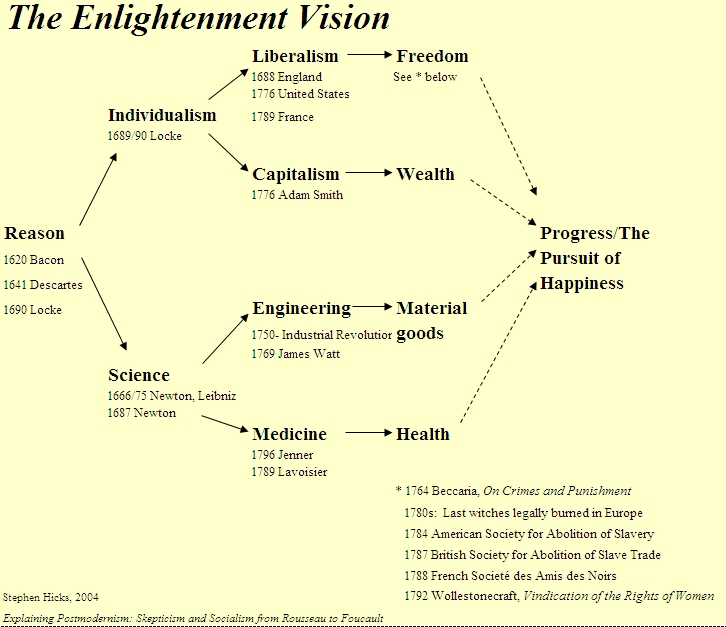
The Enlightenment Vision — updated flowchart

The Enlightenment of the long 18th century was an era of awesome intellectual and cultural transformation.

hickss-enlightenment-vision-flowchart-full

This Enlightenment Vision flowchart is pitched at a high level of abstraction, showing schematically how the philosophical revolution of the 17th century led to the 18th-century revolutions in science, technology, politics, and economics — which in turn led to the dramatic increases in health, wealth, freedom, and goods in the 19th century.

To put it another way, the chronology shows how the ideas played out as philosophy, then as an intellectual movement, then as activism, then as the working technology of culture.

I first develop the chart for my courses in philosophy and intellectual history and published a version of it in Explaining Postmodernism. It’s posted here as a PDF, as a JPEG image, or as an Excel file, in case you’d like to adapt it for your own purposes.

(Thanks to Brian Schwartz for prompting this update.)

Posted 3 months, 2 weeks ago at 8:42 pm.

4 comments

Interview with Douglas Den Uyl on “The Essence of Capitalism”

Douglas Den Uyl spoke at Rockford College on four competing (and/or compatible?) theories of the nature of capitalism: Milton Friedman’s “Utility” account, Friedrich Hayek’s “Epistemic” account, Adam Smith’s “Aesthetic” account, and Ayn Rand’s “Self-Fulfillment” account.

Here is my sixteen-minute interview with Dr. Den Uyl following his lecture:

Part 1:

Part 2:

Cross-posted at the CEE site.

Posted 4 months, 2 weeks ago at 9:57 am.

Add a comment

Adam Smith on slaves to fashion

Not a perfect analogy, but a disturbing anecdote and an intriguing comparison:

portrait-bianca-ponzoni-anguissola-100x127“Some of the savage nations in North America tie four boards round the heads of their children, and thus squeeze them, while the bones are tender and gristly, into a form that is almost perfectly square. Europeans are astonished at the absurd barbarity of this practice, to which some missionaries have imputed the singular stupidity of those nations among whom it prevails. But when they condemn those savages, they do not reflect that the ladies in Europe had, till within the very few years, been endeavouring for near a century to squeeze the beautiful roundness of their natural shape into a square form of the same kind.”

That’s from Smith’s 1759 The Theory of Moral Sentiments, IV.1, p. 326.

The image is Sofonisba Anguissola’s Portrait of Bianca Ponzoni Anguissola.

Posted 1 year, 9 months ago at 8:15 pm.

2 comments

APEE talk on the mixed economy

apee-50x89At the APEE conference next month in Las Vegas, I will be presenting “The Evolution of the Mixed Economy - A Schematic Approach.”

My talk integrates themes from several major thinkers from whom I have learned a great deal: Adam Smith, Ludwig von Mises, Ayn Rand, Friedrich Hayek, Milton Friedman, James Buchanan, and Gordon Tullock.

longer-150x1501The talk’s outline is based on this flow chart posted earlier under the title “Pathologies of the mixed economy (or, How we got into this frackin’ mess).”

For the conference I’ve also organized two other sessions: Ethics and the Financial Crisis and Reason in Hayek and Rand.

Here is the full conference schedule.

Posted 1 year, 10 months ago at 3:39 pm.

Add a comment

Reading group on Adam Smith’s Theory of Moral Sentiments

smith-reading-group-100pxMy colleagues in the Department of Philosophy, Shawn Klein and Matthew Flamm, will be leading a reading group on Adam Smith’s The Theory of Moral Sentiments.

Adam Smith is best known as an economist and a critic of mercantilism and as an early advocate of market economies. Less well known is Smith the moral philosopher. His famous On the Wealth of Nations was published in 1776, while his Theory of Moral Sentiments was published seventeen years earlier. Smith’s ethical theories are of interest in their own right, as are their connections to economic views about freer markets.

Concurrently, Professor Klein is teaching our Ethical Theory course, which will include a unit on David Hume. And one our guest speakers this semester, Professor William Kline, will be speaking at Rockford College on Hume. So Scottish Enlightenment moral philosophy is getting a big hearing at Rockford College this semester.

burpee-nightThe first meeting will be on Friday, January 22 at 1 p.m. in the Center for Ethics and Entrepreneurship office in the Burpee Center. Here is a Rockford College campus map. A free copy of Smith’s book will be provided to all participants.

The reading group is sponsored by Center for Ethics and Entrepreneurship.

Posted 2 years ago at 8:54 am.

Add a comment